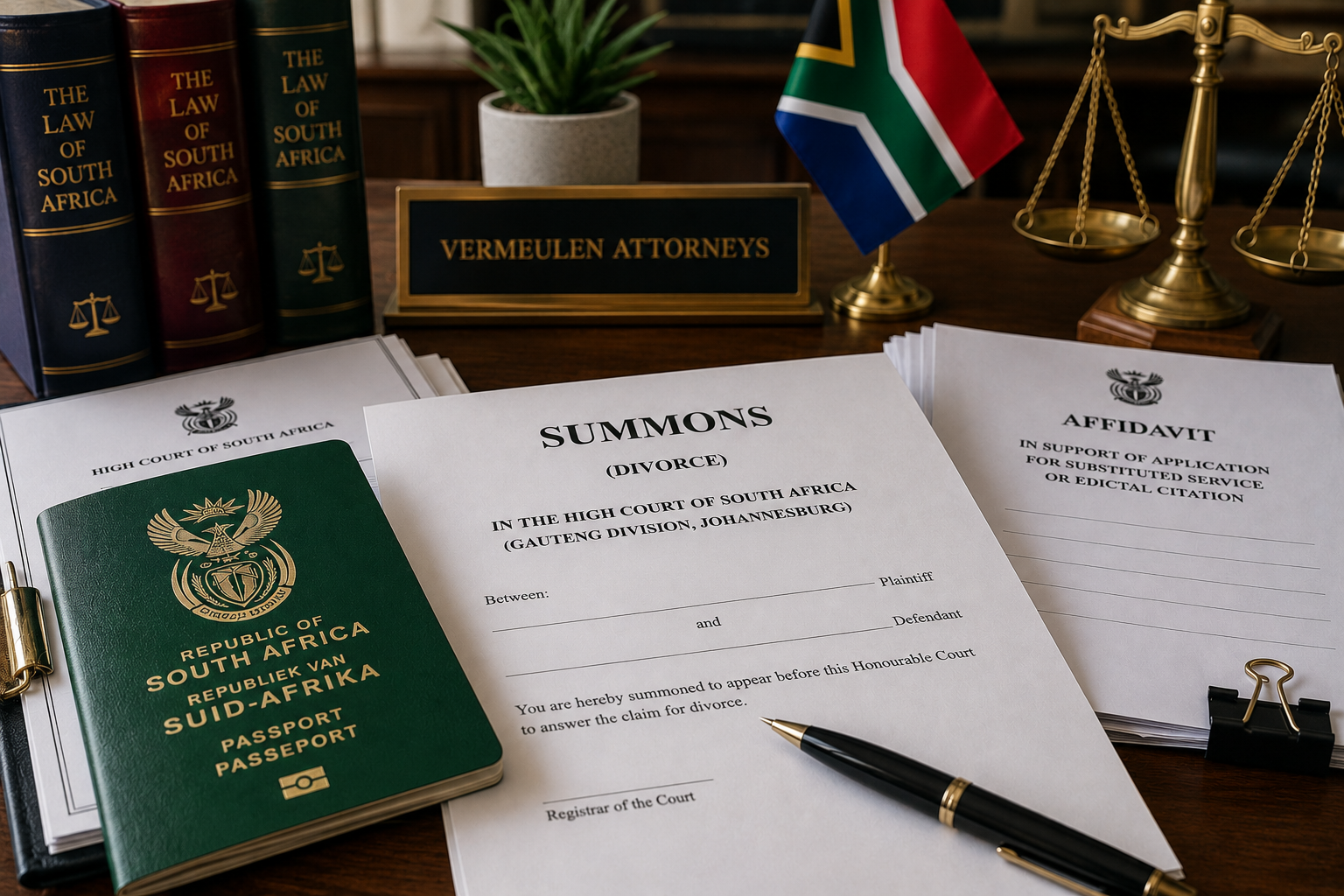
Substituted service in divorce proceedings may become necessary where a spouse cannot be found, avoids contact, or refuses to cooperate with the service of divorce papers. Many people believe that they cannot proceed with a divorce unless they physically locate their spouse. In South African law, that is not always the case.
Where ordinary service by the Sheriff is not possible, a court may authorise another method of service if it is satisfied that the proposed method is reasonably likely to bring the divorce proceedings to the other spouse’s attention.
At Vermeulen Attorneys, we assist clients with divorce matters where a spouse is absent, untraceable, or avoiding service. These matters require careful preparation because defective service can delay the divorce and may affect the validity of later steps in the proceedings.
What Is Substituted Service in Divorce Proceedings?
Substituted service is a court-authorised method of serving legal documents in a manner other than ordinary personal service by the Sheriff.
In divorce proceedings, this is particularly important because divorce summons must ordinarily be served personally on the Defendant. Rule 44 of the Uniform Rules of Court provides that a process claiming a decree of divorce must be served personally, unless service other than personal service is authorised by the court.
Where the Defendant is believed to be in South Africa but cannot be located, Rule 4(2) of the Uniform Rules allows the High Court to give directions on how service may be effected. The court will only do so where ordinary service is not possible and the proposed alternative method is appropriate in the circumstances.
Substituted Service vs Edictal Citation
Substituted service and edictal citation are related procedures, but they are not the same.
- Substituted service is usually used where the Defendant is believed to be within South Africa, but their exact whereabouts are unknown or ordinary service has failed.
- Edictal citation is generally used where the Defendant is outside South Africa or service must take place outside the Republic.
This distinction matters because the court must be approached under the correct procedure. Using the wrong procedure may result in the application being refused or the divorce being delayed.
When May a Court Authorise Substituted Service?
A court may consider substituted service where the spouse cannot be served in the ordinary way. This may occur where:
- the spouse’s current residential address is unknown;
- the Sheriff has attempted service but could not locate the spouse;
- the spouse appears to be deliberately avoiding service;
- the spouse has moved without providing a forwarding address;
- family members, employers, or acquaintances cannot confirm the spouse’s whereabouts; or
- available contact details suggest that another method of service may be more effective.
The purpose of substituted service is not to bypass the Defendant’s rights. It is to ensure that reasonable and fair steps are taken to notify the Defendant of the proceedings where ordinary service is not possible.
What Must Be Proven in a Substituted Service Application?
An application for substituted service must be supported by a proper affidavit. The court will usually expect the Applicant to explain:
- what attempts were made to locate the Defendant;
- why personal service by the Sheriff could not be achieved;
- why the Applicant believes the Defendant is still within South Africa, if that is the case;
- what alternative method of service is proposed; and
- why that method is reasonably likely to bring the divorce proceedings to the Defendant’s attention.
Possible supporting evidence may include:
- Sheriff’s returns of non-service;
- tracing reports;
- emails, WhatsApp messages, or SMS records;
- proof of previous communication with the Defendant;
- social media profile information;
- correspondence with family members or employers; and
- details of the Defendant’s last known address or employment.
The court retains a discretion. The stronger and more detailed the evidence, the better the prospects of obtaining an order that permits substituted service.
How Can Divorce Papers Be Served by Substituted Service?
The method authorised by the court will depend on the facts of the case. A court may authorise service by one or more of the following methods:
- email;
- WhatsApp;
- SMS;
- Facebook or another social media platform;
- publication in a newspaper;
- delivery to a family member or employer;
- affixing the summons to the Defendant’s last known address; or
- another method that the court considers appropriate.
Modern communication methods may be appropriate where there is evidence that the relevant email address, mobile number, or social media profile belongs to the Defendant and is actively used. The court must be satisfied that the proposed form of service is not merely convenient, but reasonably likely to provide notice.
Can You Divorce a Spouse Who Cannot Be Found?
Yes, it may be possible to proceed with a divorce where a spouse cannot be found, provided the correct court procedure is followed.
Once the court grants an order for substituted service, the divorce papers must be served strictly in accordance with that order. If the Defendant still fails to respond within the required time period, the divorce may proceed on an undefended basis, subject to the court being satisfied that the procedural and substantive requirements have been met.
This means that a person is not necessarily trapped in a marriage simply because the other spouse has disappeared, refuses to communicate, or avoids the Sheriff.
What If There Are Children Involved?
Where minor children are involved, the court will consider more than the service issue. Divorce proceedings involving children must also deal properly with care, contact, guardianship, maintenance, and the best interests of the child.
Section 28 of the Constitution of the Republic of South Africa provides that a child’s best interests are of paramount importance in every matter concerning the child. The Children’s Act 38 of 2005 also requires child-related decisions to be approached with the child’s best interests as the central consideration.
Where the absent spouse is also a parent or guardian, additional care may be needed to ensure that the divorce papers, parenting proposals, and any related relief are properly presented to the court. You can read more about our work in children’s matters, parenting plans, and child maintenance.
Why Proper Legal Assistance Is Important
Applications for substituted service must be carefully drafted. A vague affidavit or unsupported allegation that a spouse “cannot be found” is usually not enough. The court must be placed in a position to understand what was done, why ordinary service failed, and why the proposed alternative method is fair.
At Vermeulen Attorneys, we assist clients with:
- applications for substituted service;
- divorce matters involving absent or untraceable spouses;
- uncontested divorce proceedings;
- contested divorce proceedings;
- divorce matters involving minor children;
- procedural compliance with applicable court rules; and
- practical guidance on the evidence required to support the application.
Speak to a Divorce Attorney About Substituted Service
If you cannot find your spouse, or your spouse is avoiding service of divorce papers, you may still have legal options. The correct approach depends on where your spouse is believed to be, what steps have already been taken, and which court has jurisdiction over the divorce.
Vermeulen Attorneys can assess your circumstances, advise on the appropriate procedure, and assist with the necessary application to court.
Contact us today to schedule a consultation.
Contact Vermeulen Attorneys for professional assistance with substituted service in divorce proceedings and related divorce matters.
Frequently Asked Questions About Substituted Service in Divorce Proceedings
What is substituted service in divorce proceedings?
Substituted service in divorce proceedings is a court-authorised method of serving divorce papers in a way other than ordinary personal service, usually where the Defendant cannot be located or ordinary service has failed.
Can I get divorced if my spouse cannot be found?
Yes, it may be possible. You will usually need to approach the court for permission to serve the divorce papers by substituted service or, where the spouse is outside South Africa, by edictal citation.
Can divorce papers be served by WhatsApp or email in South Africa?
In appropriate cases, a court may authorise service by WhatsApp, email, or another electronic method. The Applicant must provide evidence that the contact details belong to the Defendant and that the proposed method is likely to bring the proceedings to their attention.
What evidence is needed for substituted service?
Common evidence includes Sheriff’s returns of non-service, tracing reports, affidavits explaining search efforts, prior correspondence, social media information, and details from family members, employers, or acquaintances.
Is substituted service the same as edictal citation?
No. Substituted service is generally used where the Defendant is believed to be in South Africa but cannot be served personally. Edictal citation is generally used where the Defendant is outside South Africa or service must occur outside the Republic.
What happens after substituted service is granted?
The divorce papers must be served exactly as authorised in the court order. If the Defendant does not respond within the required time, the matter may proceed further, including potentially on an undefended basis.
Do I need an attorney for substituted service?
Legal assistance is strongly recommended because the application must be properly supported by evidence and must comply with the applicable court rules. Errors can cause delay, additional costs, or refusal of the application.