International relationships are more common than ever. People fall in love across borders, build lives in different countries, and sometimes—despite their best intentions—those relationships come to an end. When that happens, the legal process can quickly become complicated. An international divorce South Africa case is rarely straightforward. It often involves multiple legal systems, questions about jurisdiction, and assets spread across countries.
If you’re facing a cross-border divorce, you’re probably asking yourself: Where do I file? Which country’s law applies? What happens if my spouse lives overseas? These are not small questions. They affect your financial future, parental rights, and peace of mind. In this guide, we unpack how an international divorce South Africa matter usually works, what South African courts look at first, and the practical issues that arise when people, property, and paperwork are spread across jurisdictions.
Whether you’re worried about a divorce where a spouse lives overseas, trying to understand the implications of foreign assets, or simply trying to figure out where to start, an international divorce South Africa approach is all about clarity: confirming jurisdiction, ensuring proper service, and planning for enforcement if the other party (or the assets) sits outside South Africa.
Understanding International Divorce in South Africa
An international divorce South Africa matter arises when a marriage has meaningful connections to more than one country. This could be because the spouses are citizens of different countries, the marriage was concluded outside South Africa, one spouse relocated to another jurisdiction, or the couple’s assets and children are tied to multiple legal systems.
Here are common “international” indicators:
- The spouses are citizens of different countries.
- The marriage took place abroad.
- One spouse lives overseas (or both live abroad but one remains domiciled in South Africa).
- Assets are located in multiple countries (property, accounts, investments, or business interests).
- Children live in a different jurisdiction, or travel frequently across borders.
In simple terms, if more than one country is legally connected to your marriage, you’re likely dealing with a cross-border divorce. South African courts do handle these matters, but each international divorce South Africa case turns on its specific facts—particularly domicile, ordinary residence, and the location of assets and children.
The reason the label matters is that international elements tend to add extra steps. You may need to serve documents abroad, prove foreign marriage validity, obtain translations or apostilles, or plan for enforcement outside South Africa. So while the fundamentals of divorce still apply, an international divorce South Africa strategy usually involves more planning and more paperwork.
Jurisdiction in International Divorce South Africa
Jurisdiction is the backbone of any international divorce South Africa case. If a court does not have the legal authority to hear your matter, it cannot grant a divorce order—no matter how strong your personal reasons are. This is why jurisdiction is usually the first “gate” you must pass through.
Under South African law, a court may exercise jurisdiction if:
- One of the spouses is domiciled in South Africa at the time proceedings are instituted, or
- One of the spouses is ordinarily resident in South Africa and has been so for at least one year immediately before filing.
This means that even in a divorce where a spouse lives overseas, South African courts may still have jurisdiction if the other spouse is domiciled or ordinarily resident locally. Domicile is your “permanent home” concept—the place you intend to remain or return to. Ordinary residence is more practical: where you actually live day-to-day and have settled in a stable way.
In many cross-border divorce scenarios, both South Africa and another country may claim jurisdiction. When that happens, the timing and location of filing can become strategic. Different jurisdictions can produce very different outcomes on maintenance, property division, and procedure. For that reason, proper advice early in an international divorce South Africa matter is not just helpful—it can shape the entire case.
Recognition of Foreign Marriages in South Africa
One common concern in an international divorce South Africa matter is whether the marriage itself is legally recognized. South Africa generally recognizes foreign marriages, provided they were validly concluded under the laws of the country where the marriage took place.
Foreign marriages commonly recognized include:
- Civil marriages
- Religious marriages (where valid under foreign law and relevant requirements are met)
- Customary marriages (in certain circumstances, depending on validity requirements)
In practice, the court will want proof of the marriage and may require official documents if the marriage certificate is foreign. Depending on the country, you might need certified copies, translations, and in some cases an apostille or other authentication method. Once the marriage is accepted as valid, an international divorce South Africa case can proceed if jurisdiction requirements are satisfied.
Importantly, recognition of a foreign marriage does not mean South Africa automatically adopts foreign divorce rules. The divorce process will generally proceed under South African law once the local court has jurisdiction. That’s why many people choose an international divorce South Africa filing when they live in South Africa or remain domiciled here, even if the marriage began elsewhere.
Divorce Where a Spouse Lives Overseas: How the Process Works
Many people worry that if their spouse is abroad, they cannot proceed with divorce. That’s not true. A divorce where a spouse lives overseas can still be handled through an international divorce South Africa case, provided the court has jurisdiction.
The process commonly involves:
- Establishing jurisdiction (domicile or ordinary residence criteria).
- Issuing and serving divorce papers on the spouse abroad.
- Allowing time for a response (international service often means longer timelines).
- Proceeding by settlement or trial (or, in some cases, default if there’s no response and service is proven).
Service of documents internationally can be complex. Depending on where your spouse lives, you may need to comply with international processes such as the Hague Service Convention. Even where conventions apply, the key point is this: the court must be satisfied that your spouse was properly notified. In an international divorce South Africa matter, “proper service” is not a technicality—it’s what protects the integrity of the proceedings.
If the overseas spouse doesn’t participate, the case may still proceed on a default basis, but only if service was correctly done and proven. With the right procedure, an international divorce South Africa case can move forward even when the other party resides abroad.
Division of Assets in a Cross-Border Divorce
Asset division is often the most contentious part of any divorce, and it becomes even more complicated in an international divorce South Africa context when property and finances are spread across jurisdictions. The practical challenge is not only what the court orders, but how those orders are enforced if assets are located outside South Africa.
Common complications include:
- Property located in different countries (homes, apartments, land).
- Bank accounts and investments held abroad.
- Businesses operating internationally or registered offshore.
- Pensions, retirement funds, trusts, or share portfolios connected to foreign rules.
South African courts can grant orders regarding assets outside the country, but enforcement may require recognition in the foreign jurisdiction. In many international divorce South Africa cases, the matrimonial property regime still plays a central role—whether the marriage is in community of property, out of community with accrual, or out of community without accrual. The regime influences what each party is entitled to, but the “real-world” question becomes: how do you actually implement the outcome if the asset is overseas?
For example, a South African court may award a share of foreign property in an international divorce South Africa matter, but you may need to take additional steps in the country where the property is located. That’s why strategic planning matters: identifying where assets are, how they are owned, and what enforcement tools exist in each relevant country.
Child Custody and Parenting Plans Across Borders
Children complicate any divorce—but even more so in an international divorce South Africa case. When one parent lives abroad (or plans to relocate), questions about stability, schooling, travel, and contact arrangements become central.
Common cross-border parenting issues include:
- Where the child will primarily live.
- Whether relocation is permitted, and under what conditions.
- International travel permissions, passports, and consent requirements.
- Holiday schedules that consider school calendars in different countries.
- Long-distance contact arrangements (video calls, extended holiday visits, split travel costs).
South African courts prioritize the best interests of the child. In an international divorce South Africa situation, that usually means creating a practical plan that minimizes disruption while preserving meaningful relationships with both parents where possible. Parenting plans often become more detailed in cross-border cases, because ambiguity can lead to conflict when different countries, time zones, and school systems are involved.
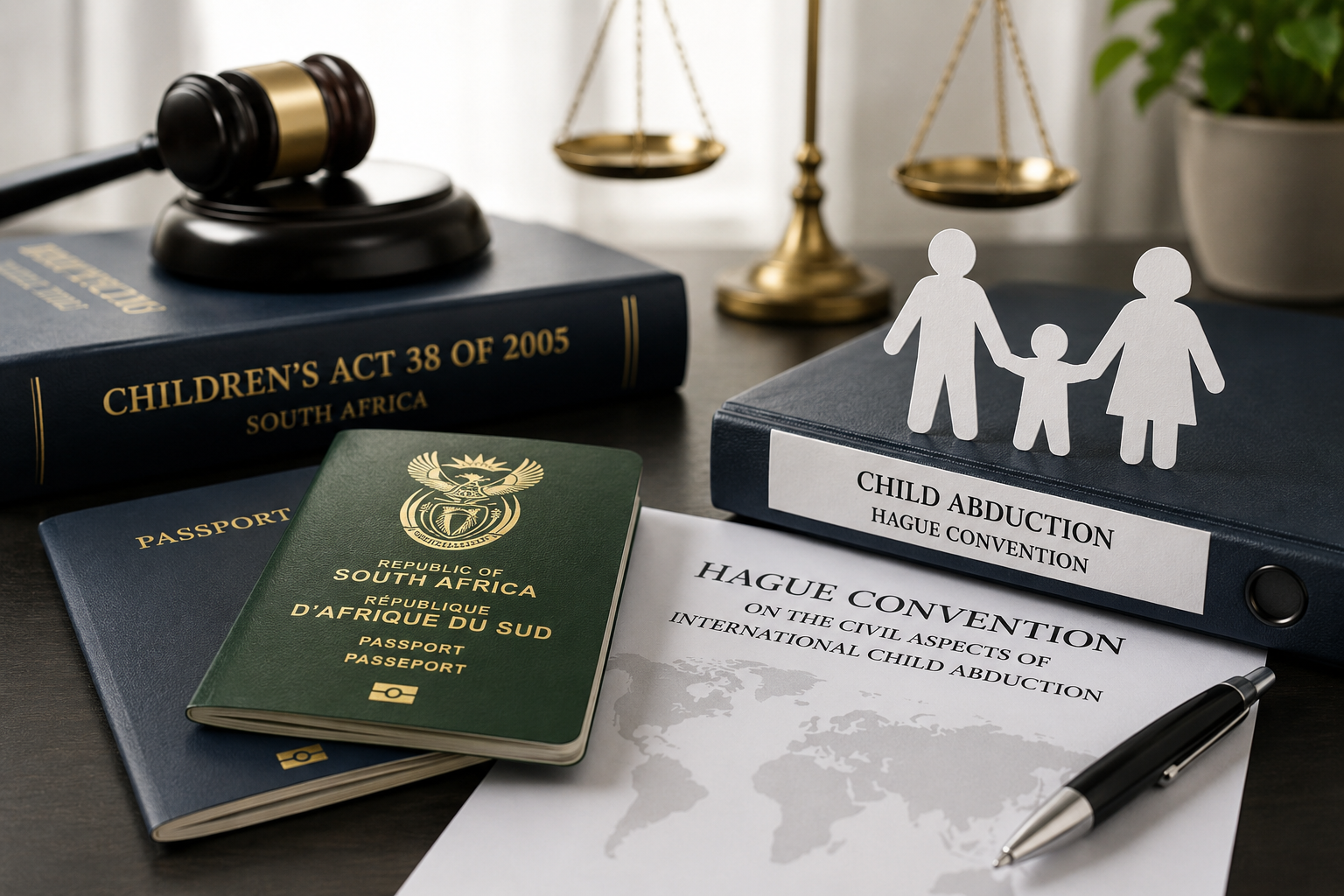
International conventions such as the Hague Convention on International Child Abduction may also be relevant in some circumstances, especially if there are concerns about wrongful removal or retention. The key is to address cross-border risks and logistics early in an international divorce South Africa matter, rather than trying to fix problems after a move has already happened.
Maintenance and Financial Support When Income Is Earned Abroad
Maintenance (spousal and child support) becomes more complex in an international divorce South Africa case when one party earns income abroad or is paid in foreign currency. Courts will generally consider affordability and needs, but international elements can affect the calculation and enforcement.
Typical considerations include:
- Exchange rates and currency fluctuations.
- Differences in cost of living between countries.
- Income stability and how predictable foreign earnings are.
- Proof of earnings when payslips, tax returns, or banking records come from abroad.
Enforcement is often the bigger challenge in a cross-border scenario. South African courts can grant maintenance orders, but enforcing them in another country may require cooperation mechanisms or reciprocal arrangements. In an international divorce South Africa matter, it’s wise to treat maintenance not only as a legal question, but also as an enforcement plan: how will payments be monitored, what happens if payments stop, and what steps can realistically be taken if the paying party is abroad?
Even in a divorce where a spouse lives overseas, you are not automatically deprived of maintenance remedies. But successful outcomes usually come from careful documentation and a strategy that anticipates cross-border complications in an international divorce South Africa case.
Enforcement of South African Divorce Orders Abroad
Winning a judgment is one thing. Enforcing it internationally is another. In an international divorce South Africa matter, enforcement often determines whether a court order becomes a practical reality or just a piece of paper.
Enforcement abroad depends on factors such as:
- Whether the foreign country recognizes South African court orders.
- Any bilateral agreements or reciprocal enforcement mechanisms.
- The local laws and procedure of the foreign jurisdiction.
- Whether additional recognition proceedings are required (sometimes called “registration” or “recognition”).
Some countries readily recognize South African divorce decrees, while others require separate applications before any enforcement can occur. In an international divorce South Africa case involving foreign assets or an overseas spouse, knowing the enforcement landscape upfront can save enormous time and expense later.
A practical approach is to identify the key “pressure points” in a cross-border divorce: Where are the assets? Where does the spouse earn income? Where can an order be most effectively enforced? Answering those questions early can shape negotiations and settlement discussions in an international divorce South Africa context.
Tax Implications in Cross-Border Divorce
Tax is often overlooked in an international divorce South Africa case, but it can significantly affect the real value of a settlement—especially where property transfers, offshore investments, and cross-border payments are involved.
Potential tax-related issues may include:
- Capital gains tax implications when property is transferred or sold.
- Tax residency status (which can change depending on where you live and work).
- Currency exchange implications and timing of transfers.
- Offshore trusts, companies, or investment structures with their own compliance requirements.
A cross-border divorce can trigger tax exposure in more than one country. That’s why it’s often sensible for parties to coordinate legal and financial advice, especially where large assets or complex structures exist. In an international divorce South Africa matter, “what you get” on paper may differ from what you keep after tax, fees, and currency conversion are factored in.
Maintenance can also carry tax consequences depending on the countries involved. Even if South African rules apply to the divorce itself, the practical tax treatment of payments may be affected by foreign laws when one spouse lives overseas. In short: tax planning is not a luxury in an international divorce South Africa situation—it’s part of protecting your long-term outcome.
Choosing the Right Jurisdiction in International Divorce South Africa
When both South Africa and another country have jurisdiction, choosing where to file becomes strategic. This is a common turning point in an international divorce South Africa scenario: you may be legally allowed to file in more than one place, but the consequences can differ dramatically.
Key factors that may influence jurisdiction strategy include:
- How property division is handled in each forum.
- Maintenance rules and typical outcomes.
- Speed, cost, and complexity of proceedings.
- How easily orders can be enforced in the country where assets or income exist.
In some cross-border divorce situations, filing first can secure a particular forum and influence the rest of the process. Because timing can matter, delaying can reduce your options. An experienced practitioner can help assess whether an international divorce South Africa filing is the most practical and protective route based on your residence, domicile, family circumstances, and asset footprint.
Practical Steps If You’re Considering an International Divorce
If you believe you’re facing an international divorce South Africa matter, preparation can reduce stress and prevent costly missteps. Cross-border cases tend to punish disorganization because documents, bank records, and proof of residence may exist in different countries and formats.
Practical steps to consider:
- Gather financial documentation (bank statements, property documents, investments, debts, business records).
- Confirm residency and domicile status (your own and, where possible, your spouse’s).
- Identify location of assets (including offshore accounts or property held through companies or trusts).
- Get advice early to plan jurisdiction, service, and enforcement strategy.
- Avoid relocating children or making travel changes without legal guidance.
In a divorce where a spouse lives overseas, early preparation prevents avoidable delays—like having to redo service, scrambling to authenticate foreign documents, or discovering late in the process that enforcement in another jurisdiction will be difficult. A thoughtful international divorce South Africa strategy sets you up for a smoother path, whether the matter resolves by agreement or requires litigation.
FAQ: International Divorce
Can I divorce in South Africa if my spouse lives abroad?
Answer: Yes. A South African court may have jurisdiction if either party is domiciled or ordinarily resident in South Africa.
What is a cross-border divorce?
A cross-border divorce occurs when a marriage has legal ties to more than one country. This may involve different nationalities, residences, assets located internationally, or children living across jurisdictions. In many cases, a cross-border divorce also requires additional steps for international service and enforcement.
Will South Africa recognise my foreign marriage?
Yes, provided the marriage was legally valid in the country where it was concluded. In an international divorce South Africa matter, recognition of the marriage is a key starting point before divorce proceedings can be finalized.
Can South African courts divide overseas property?
Yes, courts can make orders regarding foreign assets. However, enforcing those orders in a foreign country may require additional legal steps, depending on that jurisdiction’s recognition and enforcement rules.
How long does an international divorce take?
A cross-border divorce may take longer than a local divorce due to service requirements, jurisdictional questions, foreign documentation, and enforcement planning. Timeframes depend heavily on complexity and the level of cooperation between parties.
Final Thoughts
An international divorce South Africa matter is rarely just a legal file—it’s a life re-organisation across borders. Jurisdiction, foreign marriage recognition, serving a spouse overseas, dividing assets abroad, and creating workable parenting and maintenance solutions can feel like a maze. But with the right structure, the maze becomes manageable.
The most important lesson is this: international elements don’t prevent divorce in South Africa, but they do require planning. If your spouse lives overseas, if assets sit outside the country, or if children move between jurisdictions, you want to think beyond the divorce order itself. You want to think about enforceability, practical outcomes, and what will still work a year from now—after the paperwork is done.
If you approach the process strategically, an international divorce South Africa case can be handled efficiently and fairly, even when geography complicates communication and cooperation. The earlier you get clarity on jurisdiction and enforcement, the stronger your position will be—whether you’re negotiating a settlement or proceeding through court.