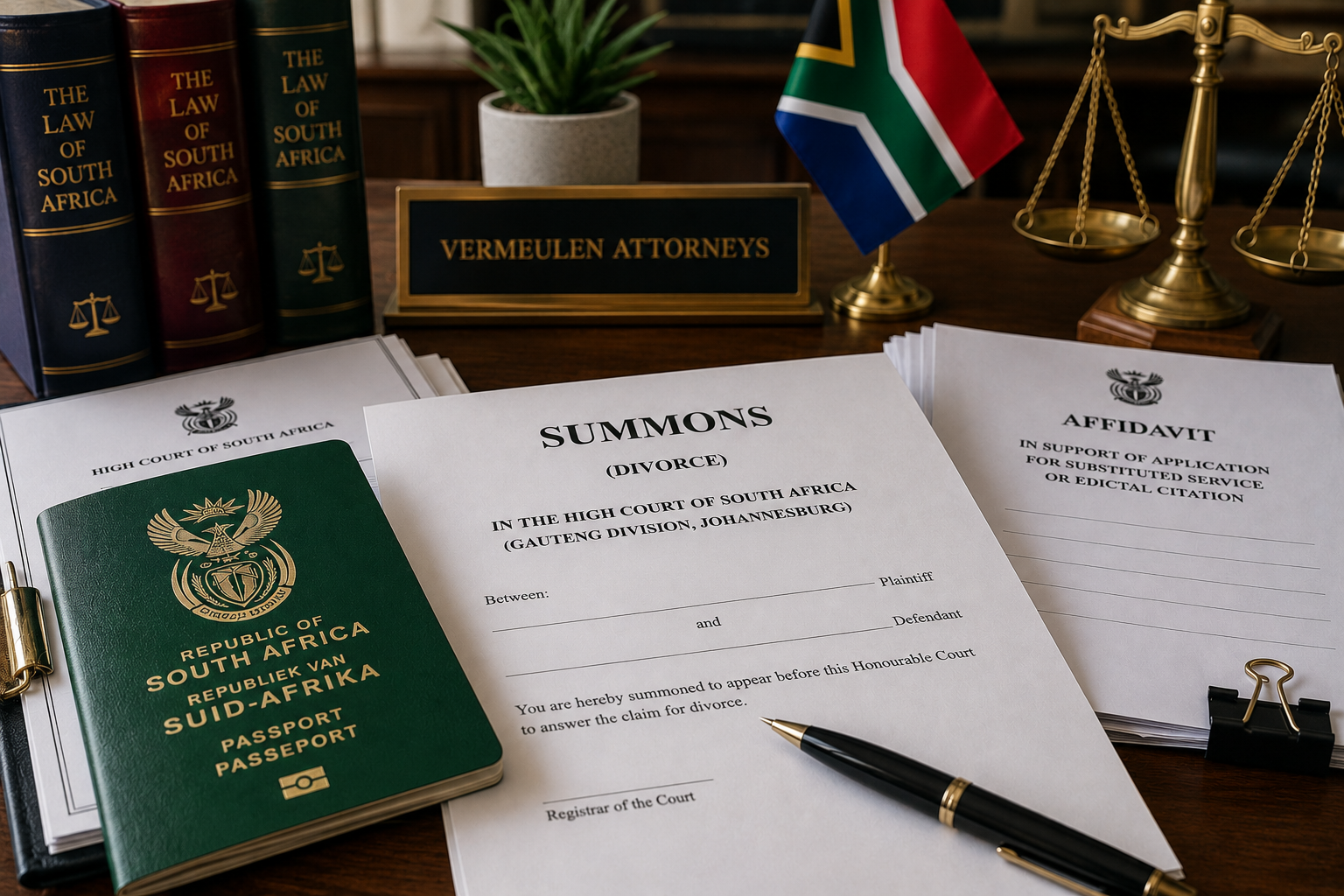
One of the most common misconceptions about divorce proceedings in South Africa is that a divorce cannot continue if one spouse cannot be found, refuses to cooperate, or has moved overseas.
In reality, South African law provides remedies where ordinary service of divorce papers is not possible. Two procedures often used in these circumstances are edictal citation and substituted service.
Although these terms are sometimes used interchangeably, they are legally distinct. Understanding edictal citation vs substituted service is important because the correct procedure depends mainly on whether the other spouse is outside South Africa or believed to be within South Africa but cannot be served in the usual way.
At Vermeulen Attorneys, we assist clients with local, contested, uncontested and international divorce matters, including cases where a spouse cannot be traced or service must take place outside South Africa.
Understanding Edictal Citation vs Substituted Service
The difference between edictal citation and substituted service lies in the location of the defendant and the reason ordinary service cannot take place.
- Edictal citation is generally used where divorce papers must be served outside the Republic of South Africa.
- Substituted service is generally used where the defendant is believed to be in South Africa, but personal service by the sheriff is not possible or practical.
Both procedures require a court application supported by affidavit evidence. The court must be satisfied that the proposed method of service is appropriate and reasonably likely to bring the divorce proceedings to the other spouse’s attention.
What Is Edictal Citation in Divorce Proceedings?
Edictal citation is a procedure where a court grants permission for legal documents to be served outside South Africa.
In High Court proceedings, Rule 5 of the Uniform Rules of Court provides that, unless the court grants leave, no process or document instituting proceedings may be served outside the Republic. This means that a party cannot simply send divorce summonses abroad without first obtaining the necessary court authority.
Edictal citation is commonly required where:
- the defendant lives outside South Africa;
- the defendant has emigrated;
- the defendant’s foreign address is known;
- the divorce papers must be served in another country; or
- the divorce has an international or cross-border element.
This often arises in international divorce matters where one spouse remains in South Africa and the other spouse resides abroad.
How Are Divorce Papers Served Through Edictal Citation?
The court will determine the appropriate method of service based on the facts placed before it. Depending on the circumstances, the court may authorise service by:
- a foreign sheriff, process server or equivalent official;
- registered international post or courier;
- email;
- diplomatic or consular channels;
- service through an attorney abroad; or
- another method that the court considers suitable.
The applicant must explain why the proposed method is reliable and why it is likely to bring the divorce proceedings to the defendant’s attention. The court’s focus is not merely procedural compliance. It must also be satisfied that the defendant will receive proper notice of the proceedings.
What Is Substituted Service in Divorce Proceedings?
Substituted service applies where the defendant is believed to be within South Africa, but ordinary personal service cannot be carried out.
Personal service is ordinarily effected by the sheriff. However, there are situations where this is not possible despite reasonable efforts. In those circumstances, the court may authorise another method of service.
Substituted service is commonly used where:
- the defendant is avoiding service;
- the defendant’s exact whereabouts are unknown;
- the sheriff has attempted service without success;
- the defendant has absconded;
- the defendant is moving between addresses; or
- ordinary service methods have failed.
This may arise in both contested divorce and uncontested divorce matters, particularly where one spouse is attempting to delay the legal process.
Examples of Substituted Service
The method of substituted service depends on the facts of each case. A court may authorise service by:
- email;
- WhatsApp;
- SMS;
- Facebook or another social media platform;
- publication in a newspaper;
- service on a family member;
- service on an employer;
- service at a last known address; or
- another method shown to be reasonably effective.
Modern communication methods such as WhatsApp or email may be considered where there is evidence that the defendant actively uses that method of communication. The court will usually require supporting facts, such as recent messages, delivery indicators, email correspondence or other proof linking the defendant to the proposed method of service.
Edictal Citation vs Substituted Service: The Key Difference
The key distinction can be summarised as follows:
- Edictal citation is used where service must take place outside South Africa.
- Substituted service is used where the defendant is believed to be in South Africa, but ordinary service cannot be achieved.
This distinction matters because using the wrong procedure can cause unnecessary delay, additional costs, or the removal of the matter from the court roll.
What Must the Court Application Show?
An application for edictal citation or substituted service must be properly prepared and supported by a detailed affidavit. The affidavit should usually explain:
- the background to the divorce matter;
- where the defendant is believed to be;
- the defendant’s last known address and contact details;
- the steps taken to locate the defendant;
- the attempts made to serve the divorce papers;
- why ordinary service is not possible;
- why the proposed method of service is suitable;
- whether the defendant is likely to receive notice through that method; and
- the relief sought from the court.
Where children, maintenance, property division or other important issues are involved, the application must be approached with particular care. The service process must be legally sound so that the divorce proceedings are not later challenged on procedural grounds.
Can You Still Get Divorced If You Cannot Find Your Spouse?
Yes. A spouse cannot necessarily prevent a divorce simply by disappearing, avoiding service, relocating overseas or refusing to cooperate.
Provided the correct legal process is followed, a divorce may still proceed where the court is satisfied that reasonable steps have been taken and that the method of service authorised is appropriate.
This means that a divorce may proceed even where the other spouse:
- cannot be found;
- has emigrated;
- lives overseas;
- refuses to communicate;
- avoids the sheriff;
- has changed address repeatedly; or
- has cut off contact completely.
If you are unsure whether your matter should proceed by edictal citation, substituted service or another procedural route, it is advisable to obtain legal advice before issuing or serving divorce papers.
Why Proper Legal Assistance Matters
Applications for edictal citation and substituted service are procedural applications, but they can have significant practical consequences. If the application is incomplete, vague or unsupported by proper evidence, the court may refuse the order or require further information.
At Vermeulen Attorneys, our divorce attorneys assist clients with:
- applications for edictal citation;
- applications for substituted service;
- divorce proceedings where a spouse cannot be found;
- divorce matters involving a spouse living overseas;
- international divorce and cross-border service issues;
- contested and uncontested divorce proceedings; and
- High Court and Regional Court divorce procedure.
We understand that these matters are not merely procedural. They often arise during emotionally stressful periods where clients need clarity, structure and decisive legal guidance.
Speak to Vermeulen Attorneys About Edictal Citation or Substituted Service
Not knowing where your spouse is should not necessarily prevent you from obtaining legal closure. South African law provides remedies where a spouse cannot be traced, refuses to cooperate or resides outside the country.
At Vermeulen Attorneys, we can assess your circumstances, advise you on the correct procedure, prepare the necessary court application and guide you through the divorce process with care and precision.
Contact us today to schedule a consultation.
Frequently Asked Questions About Edictal Citation vs Substituted Service
What is edictal citation in divorce proceedings?
Edictal citation is a court-authorised process used where divorce papers must be served outside South Africa. In High Court matters, the applicant must obtain the court’s permission before initiating process is served abroad.
What is substituted service in divorce proceedings?
Substituted service is a court-approved alternative method of serving divorce papers where ordinary personal service is not possible, usually because the defendant cannot be located or is avoiding service within South Africa.
What is the difference between edictal citation and substituted service?
Edictal citation is generally used where the defendant is outside South Africa. Substituted service is generally used where the defendant is believed to be in South Africa but cannot be served personally.
Can I divorce my spouse if I do not know where they are?
Yes. A divorce may still proceed if the correct application is brought and the court is satisfied that reasonable steps have been taken to locate or notify the other spouse.
Can divorce papers be served by WhatsApp?
In appropriate cases, a court may authorise service by WhatsApp if there is evidence that the defendant uses that number and that WhatsApp service is likely to bring the proceedings to their attention.
Do I need a court order for edictal citation?
Yes. Where divorce papers must be served outside South Africa, court permission is required before service may take place abroad.
Do I need a court order for substituted service?
Yes. A party must usually apply to court for permission to serve the divorce papers by an alternative method where ordinary personal service cannot be achieved.
What evidence is needed for substituted service?
The applicant should usually provide evidence of attempts to locate or serve the defendant, the defendant’s last known details, and why the proposed method of service is likely to notify the defendant.
Can my spouse stop the divorce by avoiding service?
No. Avoiding service may delay the process, but it does not necessarily prevent the divorce from proceeding. The court may authorise an alternative method of service where the facts justify it.
Why should I use an attorney for edictal citation or substituted service?
These applications must comply with the relevant court rules and must be supported by proper affidavit evidence. An attorney can help avoid procedural errors, unnecessary delays and wasted costs.