
Unfair Dismissal in South Africa: 3 Steps to Ensure Lawful Termination
Navigating employee terminations can be complex, and mistakes often result in expensive legal consequences. For employers in Roodepoort, Ballito, and across South Africa, understanding what constitutes unfair dismissal under the Labour Relations Act (LRA) is essential to minimise risk and ensure lawful termination.
This guide breaks down the steps every employer should follow to safeguard against unfair dismissal claims and protect both business interests and employee rights.
What Is Unfair Dismissal in South Africa?
A dismissal is deemed unfair if it lacks:
To avoid a finding of unfair dismissal in South Africa, both substantive and procedural fairness must be present. Substantive fairness means there must be a valid and justifiable reason for the dismissal, such as misconduct, incapacity, or operational requirements. The reason must be supported by objective evidence. Procedural fairness, on the other hand, requires that the correct process is followed before dismissal. This includes conducting an investigation, informing the employee of the allegations, allowing them to respond, holding a fair hearing, and communicating the outcome in writing. Failing in either area can result in an unfair dismissal ruling.
The burden of proof rests with the employer. If a matter is referred to the Commission for Conciliation, Mediation and Arbitration (CCMA), the employer must demonstrate both the fairness of the reason and the procedure followed.
Step 1 to Avoid Unfair Dismissal in South Africa: Ensure a Valid Reason Exists (Substantive Fairness)
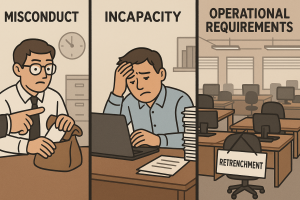
Substantive Fairness: Valid Reasons to Avoid Unfair Dismissal in South Africa
To avoid an unfair dismissal in South Africa, employers must ensure that the reason for termination is substantively fair—in other words, it must be based on valid, lawful, and factual grounds. The Labour Relations Act (LRA) outlines three main reasons that are considered legitimate for dismissal. These include misconduct, incapacity, and operational requirements. Failing to align a dismissal with one of these categories can result in a finding of unfair dismissal in South Africa, which often leads to compensation or reinstatement orders from the CCMA.
1. Misconduct
Misconduct is one of the most common reasons cited in cases of dismissal. However, to avoid an unfair dismissal in South Africa, employers must ensure the misconduct is serious enough to justify termination. Examples of misconduct include theft, fraud, insubordination, gross negligence, and repeated absenteeism.
Not every case of misconduct warrants immediate dismissal. South African labour law distinguishes between minor and serious offences. For serious offences, immediate disciplinary action may be justified, but a hearing is still essential. For less severe infractions, progressive discipline—such as verbal or written warnings—should be considered first.
Critically, the onus is on the employer to prove the misconduct occurred. This requires a thorough investigation, collection of evidence, and documentation of all related incidents. Without this, the employer risks facing an unfair dismissal in South Africa claim at the CCMA.
2. Incapacity
Incapacity relates to an employee’s inability to perform their duties, either due to poor performance, illness, or injury. When handling such cases, employers must tread carefully to avoid being accused of unfair dismissal in South Africa.
For poor performance, the employer must demonstrate that performance expectations were clear, reasonable, and communicated to the employee. The employee must also be given adequate training, supervision, and a chance to improve over a reasonable period.
In the case of illness or injury, dismissal should only be considered after all reasonable accommodations have been attempted. This might include modifying duties, adjusting working hours, or offering temporary reassignment. If these efforts fail and the employee remains incapable of performing their role, dismissal may be justified—but only with appropriate medical assessments and procedural fairness.
3. Operational Requirements (Retrenchment)
Operational requirements refer to business-related needs such as restructuring, technological changes, economic downturns, or redundancies. Retrenchments are governed by Section 189 of the LRA, which prescribes strict consultation and procedural obligations.
To avoid an unfair dismissal in South Africa, the employer must consult meaningfully with affected employees or their representatives. This includes discussing alternatives to retrenchment, selection criteria, severance pay, and the possibility of future re-employment.
Failure to follow these steps can result in the retrenchment being declared procedurally or substantively unfair.
Step 2 to Avoid Unfair Dismissal in South Africa: Follow a Fair Process (Procedural Fairness)

Even when there is a valid and lawful reason for terminating an employee, failure to follow the correct process can still result in a finding of unfair dismissal in South Africa. Procedural fairness is a critical element in every termination case. The Labour Relations Act (LRA) mandates that employers adhere to specific procedural steps to ensure that employees are treated fairly and given a proper opportunity to respond before any final decision is made.
Here’s what every employer must do to avoid unfair dismissal in South Africa:
Conduct a Thorough Investigation
Before initiating any disciplinary or dismissal process, the employer must conduct a comprehensive investigation into the alleged misconduct or incapacity. This involves gathering all relevant facts, documents, and evidence. Witnesses should be interviewed, and statements recorded. A poorly investigated case can lead to an unfair dismissal in South Africa, as it reflects a lack of due diligence and fairness.
The investigation should be objective and aim to establish whether there are grounds to proceed with a formal disciplinary hearing. Keeping detailed records throughout this process is essential, as these may be required if the matter proceeds to the Commission for Conciliation, Mediation and Arbitration (CCMA).
Notify the Employee
Once the investigation is complete and the employer believes there is a case to answer, the employee must be formally notified. This notification must be in writing, clearly outlining the allegations, charges, or operational reasons for the potential dismissal. The notice must be sufficiently detailed to allow the employee to understand the case against them.
Crucially, the employee must be given reasonable time to prepare a response. Failing to do so could result in a procedural irregularity, opening the door to a claim for unfair dismissal in South Africa.
Hold a Disciplinary or Consultation Hearing
A fair hearing is non-negotiable. For cases involving misconduct or incapacity, a disciplinary hearing must be held. During the hearing, the employee must be allowed to state their case, present evidence, call witnesses, and cross-examine any opposing witnesses. The chairperson of the hearing must be impartial and should not have been involved in the investigation.
In retrenchment scenarios, the employer must engage in meaningful consultation with the affected employees or their trade union. This includes discussing alternatives to retrenchment, severance pay, selection criteria, and possible re-employment. Failure to consult appropriately under Section 189 of the LRA is a common basis for unfair dismissal in South Africa.
Allow Representation
Employees are entitled to be represented at disciplinary hearings by a fellow employee or trade union representative. Denying representation rights is a breach of procedural fairness and can be cited in a claim of unfair dismissal in South Africa.
Provide a Written Outcome
Once a decision is reached, the employer must communicate the outcome to the employee in writing. The letter must include the decision, the reasons for dismissal (if applicable), and any rights of appeal or recourse, such as referring the matter to the CCMA. Not providing a clear outcome letter is another procedural error that could result in a ruling of unfair dismissal in South Africa.
Step 3: Use a Dismissal Checklist
Before finalising any termination, ask:
- Do I have a valid, fair reason?
- Was a thorough investigation conducted?
- Has the employee had a chance to respond?
- Have I complied with LRA procedures?
- Can I present evidence supporting my decision?
Why Compliance Matters
Even justified terminations can be declared unfair dismissals if procedures are flawed. The CCMA considers procedural fairness a critical component, and compensation may reach up to 12 months’ salary—or more in cases of automatically unfair dismissal.
Employers across South Africa must ensure that all termination decisions meet both legal and ethical standards. A small oversight can lead to significant reputational and financial repercussions.
Need Help With Employment Law Compliance?
Vermeulen Attorneys assists employers in aligning termination procedures with the Labour Relations Act to ensure compliance and minimise legal risk. From policy development to case-specific advice, we provide practical, tailored support that helps you make informed decisions.
Contact us to ensure your processes are both fair and legally defensible.
FAQs on Unfair Dismissal in South Africa
1. What is considered unfair dismissal in South Africa?
Unfair dismissal in South Africa occurs when an employer terminates an employee’s contract without both a valid reason and a fair process. Under the Labour Relations Act (LRA), two elements must be satisfied for a dismissal to be lawful: substantive fairness (a legitimate reason) and procedural fairness (a proper process). If either of these is lacking—such as dismissing an employee without proof of misconduct or without giving them a fair hearing—it may be classified as unfair dismissal in South Africa and could lead to reinstatement or compensation via the CCMA.
2. What are the valid reasons for dismissal under South African labour law?
The law recognises three primary, lawful reasons to avoid unfair dismissal in South Africa:
Misconduct: Serious or repeated offences like theft, fraud, or insubordination.
Incapacity: The employee is unable to perform duties due to poor performance, illness, or injury.
Operational Requirements: Also known as retrenchment, due to restructuring, financial difficulty, or redundancy.
Each ground must be supported by facts and evidence. Without this, the dismissal may be deemed unfair under South African labour law.
3. Do you always need a disciplinary hearing before dismissing an employee in South Africa?
Yes, for dismissals based on misconduct or incapacity, a formal hearing is essential. The employee must be allowed to state their case, respond to allegations, and be represented. For retrenchments, while not a disciplinary process, a structured consultation must take place under Section 189 of the LRA. Skipping these steps can result in unfair dismissal in South Africa, even if the underlying reason is valid.
4. Can an employer legally fire someone on the spot in South Africa?
No. Even in cases of serious misconduct, such as theft or assault, the employer must follow due process. This includes investigating the incident, informing the employee of the allegations, and holding a hearing. Instant dismissal without following this process is likely to be ruled as unfair dismissal in South Africa by the CCMA or Labour Court.
5. What is the correct procedure for dismissing an employee in South Africa?
Procedural fairness means the employee must be:
- Notified of the charges or reasons for dismissal
- Given time to prepare a defence
- Allowed to be represented at the hearing
- Given an opportunity to respond to evidence
- Issued a written outcome
- Failure to follow these steps is one of the most common reasons for unfair dismissal in South Africa.
6. How are retrenchments handled differently from other dismissals in South Africa?
Yes. Retrenchments are governed by Section 189 of the LRA and require a consultation process with the affected employees or their unions. Employers must discuss alternatives, selection criteria, severance pay, and possible re-employment. A failure to consult properly often results in unfair dismissal in South Africa, even if financial justification exists.
7. Who carries the burden of proof in an unfair dismissal case in South Africa?
In cases of unfair dismissal in South Africa, the employer carries the burden of proof. If an employee refers the matter to the CCMA, the employer must show both the fairness of the reason and the process followed. Inadequate documentation or procedural lapses can lead to costly awards against the employer.
8. Can you dismiss an employee on probation in South Africa?
Yes, but the same principles apply. Probation allows for performance assessment, but fair procedure is still required. This includes setting performance standards, providing support and feedback, and allowing time for improvement. Without this, even a probationary dismissal can amount to unfair dismissal in South Africa.
9. What are the consequences of unfair dismissal in South Africa?
If the CCMA or Labour Court finds the dismissal unlawful, the employer may be ordered to:
Reinstate the employee with back pay
Compensate the employee up to 12 months’ salary, or more in cases of automatically unfair dismissal
These consequences make avoiding unfair dismissal in South Africa critical for all employers.
10. How can employers avoid unfair dismissal in South Africa?
To reduce the risk of unfair dismissal in South Africa, employers should:
- Implement clear disciplinary and performance policies
- Follow all procedures under the LRA
- Keep detailed records of warnings, hearings, and communications
- Consult legal or HR experts before terminating employment
Proactive compliance is your best defence against disputes and CCMA referrals.