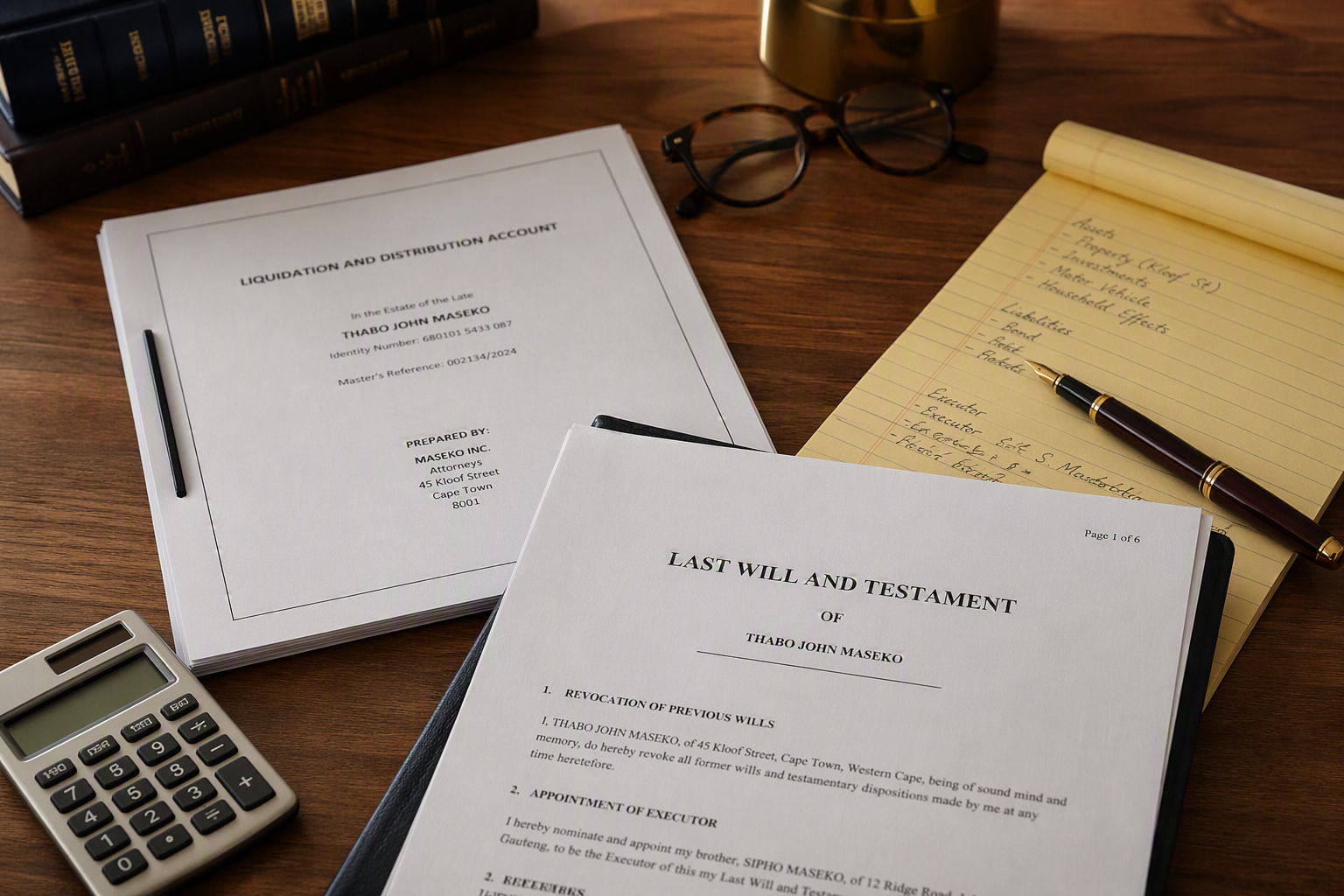
When a parent dies, the children of an earlier marriage often expect that the will controls what happens next. Then a maintenance claim by the surviving spouse lands in the liquidation and distribution account, and the inheritance shrinks — or disappears entirely. On the other side of the same problem, a widow or widower who has genuinely been left without means finds that the deceased's adult children are treating the claim as an ambush rather than a lawful entitlement under the Maintenance of Surviving Spouses Act 27 of 1990.
Both sides need to understand the same thing: a surviving spouse maintenance claim is neither automatic nor easily defeated. It is a fact-driven, evidence-driven claim, and the Supreme Court of Appeal has just restated the rules in De Bruyn v The Master of the High Court, Pretoria (26 June 2026). This article explains what the Act requires, what the De Bruyn judgment confirms, how heirs may object to the account, and where the process most often goes wrong.
What a surviving spouse maintenance claim actually is
A surviving spouse maintenance claim is a statutory claim against the deceased estate created by section 2 of the Maintenance of Surviving Spouses Act. It is not a claim founded on the marriage itself. It is a claim for the survivor's reasonable maintenance needs until death or remarriage, and only "in so far as [the survivor] is not able to provide therefor from his own means and earnings".
Two points follow from that wording, and both are commonly misunderstood.
First, marriage alone is not enough. Being married to the deceased opens the door to the Act, but it does not, by itself, establish a claim. What must be shown is a reciprocal duty of support that existed during the marriage and a genuine need that survives the death.
Second, the Act now expressly extends to a permanent life partnership in which the partners undertook reciprocal duties of support (definitions of "spouse", "marriage" and "survivor" as amended by the Judicial Matters Amendment Act 15 of 2023, in force from 3 April 2024). A qualifying life partner may bring a claim; a partner who cannot show reciprocal duties of support during the relationship cannot.
Who may object? Any interested party — an heir, a legatee, a creditor, or the executor. In blended-family estates, the objection typically comes from an adult child of the deceased's earlier marriage who is watching a stepparent's claim consume the estate the parent intended for them.
The two-limb test: reasonable need and inability to self-fund
The Act does not spell the test out as a formula, but the case law does. The classic statement is Friedrich and Others v Smit NO, and the SCA has now restated it in De Bruyn.
To succeed, a surviving spouse must prove both limbs:
- Reasonable maintenance needs. What does the survivor reasonably need to live at a maintenance standard consistent with the marriage?
- Inability to provide from own means and earnings. Even where a reasonable need is shown, the claim only survives to the extent the survivor cannot cover that need from their own resources.
Section 3 of the Act lists the factors the court and the Master must take into account:
- the amount in the estate available for distribution to heirs and legatees;
- the existing and expected means, earning capacity, financial needs and obligations of the survivor, and the subsistence of the marriage;
- the standard of living of the survivor during the marriage and the survivor's age at the death of the deceased spouse.
The list is expressly non-exhaustive — "in addition to any other factor which should be taken into account". Policy proceeds, retirement fund benefits, an inherited usufruct, or the survivor's continued earning capacity all fall within the enquiry.
Two related rules matter in practice.
- "Own means" is defined widely. Section 1 defines "own means" to include "any money or property or other financial benefit accruing to the survivor in terms of the matrimonial property law or the law of succession or otherwise at the death of the deceased spouse". A survivor who inherits a usufruct, a policy payout, or an accrual claim cannot ignore those benefits when quantifying the maintenance shortfall.
- Voluntary support from adult children is not "own means". The SCA in Oshry NO v Feldman held that voluntary financial support from adult children does not reduce the claim. That principle survives De Bruyn.
What De Bruyn adds to Friedrich and Oshry
The De Bruyn judgment is a clean SCA restatement, and it is worth reading for three reasons.
First, it reaffirms that a surviving spouse has no claim merely by reason of the marriage. The claimant must plead and prove reasonable need and inability to self-fund. Emotional and moral appeals are not enough.
Second, it confirms that where the claimant produces an actuarial calculation of maintenance needs, and the objector produces no counter-actuarial evidence and no specific factual challenge to the expense figures, a court is unlikely to disturb the actuary's assessment. The objector's mistrust of an actuary retained by the claimant is not a substitute for evidence. This is the single most damaging mistake heirs make when objecting to a liquidation and distribution account.
Third, De Bruyn confirms that the Master's practical function includes preventing the estate being rendered insolvent by the claim. Where the estate cannot satisfy the full claim, the Master will scale it, applying the ranking in section 2(3) of the Act — under which the survivor's claim ranks equally with a claim for maintenance of a dependent child, and competing claims are reduced proportionately.
None of this makes the claim untouchable. But it does mean that a heir who objects on principle, without evidence, will lose.
Objection to the liquidation and distribution account: the section 35 process
The procedure is set by section 35 of the Administration of Estates Act 66 of 1965, and it is unforgiving on time.
- The account must lie open at the Master's office (and, where applicable, the magistrate's office) for not less than 21 days — s 35(4). Notice appears in the Government Gazette and a local newspaper.
- Any person interested in the estate may lodge an objection to the liquidation and distribution account with the Master, in duplicate, before the inspection period expires, with reasons — s 35(7). In practice, it is prudent to serve a copy on the executor at the same time, to avoid the executor claiming later that they were unaware.
- The executor must transmit comments to the Master within 14 days of receipt of the objection — s 35(8).
- The Master then decides whether the objection is well-founded, and may direct the executor to amend the account or give any other direction — s 35(9).
The Master, in practice, plays a functionary role. Where the merits are clear cut, the Master will rule. Where the dispute is complex or actuarial in nature, the Master will typically decline to adjudicate and will point the parties to court. That is by design, not delay — the Act contemplates disputed maintenance claims being resolved judicially.
Facing a contested maintenance claim in a liquidation and distribution account? Speak to Cathleen Breedt and the Deceased Estates Litigation team before the inspection period closes. The 21-day window on the account and the 30-day window in section 35(10) are strict.
The 30-day clock — section 35(10) Administration of Estates Act
Once the Master has made a direction, or has refused to sustain an objection, the losing party has 30 days to apply to the High Court by motion to set that decision aside. This is the review under section 35(10) Administration of Estates Act. The court may make such order as it thinks fit. The Master must be cited as an interested party and served with the process. The executor must likewise be cited. The administration of the estate is effectively paused while the litigation is on foot.
The 30 days runs from the date of the Master's direction or refusal. Extensions are possible but not guaranteed. This is the deadline most commonly missed — often because the heir waits to see whether the executor "will do the right thing" after the Master has ruled. The section 35(10) Administration of Estates Act review clock does not stop for negotiation.
Practical steps while the clock runs:
- Obtain the account, the underlying will, the actuarial report, and every supporting document the claimant relied on.
- Instruct a counter-actuary early — the De Bruyn problem turned on the absence of counter-actuarial evidence.
- Notify the executor in writing that distribution should not proceed pending the review.
- Preserve any evidence of the survivor's independent means: bank statements, policy proceeds, retirement benefits, business interests, other property.
When removal of the executor is (and is not) the right move
Heirs frequently want the executor removed under section 54(1)(a)(v) of the Administration of Estates Act — particularly where the executor is also the surviving-spouse claimant. Section 54(1)(a)(v) allows the court to remove an executor "if for any other reason the Court is satisfied that it is undesirable that he should act as executor".
Two things must be understood.
An overlap between executor capacity and personal-claimant capacity is not automatically disqualifying. The appellant in De Bruyn raised removal at first instance and then abandoned the point on appeal — an implicit recognition that dual capacity, without more, does not meet the section 54 test. The removal of executor remedy is available where the executor has acted improperly, obstructed the administration, or has an actual conflict that has produced prejudice — not simply because the executor stands to benefit from a claim they have properly lodged.
Where removal is genuinely warranted (concealment of assets, undisclosed policies, obstructive conduct, breach of fiduciary duty), it is a strong remedy. Where it is deployed as a tactical response to a disliked claim, it will fail and can damage the objecting heir's costs position.
The surviving spouse's usufruct — what if the heirs will not move out?
De Bruyn also touched on a related problem: the surviving spouse's usufruct over the immovable property, frustrated because a co-heir was in occupation.
A usufruct in a will is a limited real right created for the survivor's benefit — typically lifelong occupation and use of the family home, or the income from it, with the bare dominium vesting in the heirs. Where the survivor cannot exercise the usufruct because a co-heir refuses to vacate, the survivor's practical benefit from the estate is reduced, and that reduction can affect the maintenance calculation.
The remedy against the occupier is eviction. Once the deceased has died and the usufruct is established, an occupier who has no right to remain must leave voluntarily or be evicted through the appropriate proceedings. The surviving spouse's usufruct being frustrated is not, on its own, a ground for enlarging the maintenance claim — but it is a factor a court will weigh, and it is a good reason to deal with the eviction question early and cleanly.
Practical guidance for heirs
- Read the account before the 21 days closes. Diarise the deadline the day the Gazette notice appears.
- Object in writing, with reasons, to the Master, and copy the executor. A one-line objection is not enough.
- Get a counter-actuary. Without independent expert evidence, an actuarial claim will usually stand.
- Attack quantum, not principle. De Bruyn is emphatic: broad-brush objections to the existence of the claim without factual challenge to the numbers rarely succeed.
- Watch the 30-day clock. If the Master rejects the objection, the section 35(10) review must be launched inside 30 days.
- Test the survivor's own means. Section 1 of the Act defines own means broadly. Policy proceeds, retirement-fund benefits, matrimonial-property claims, and other property all reduce the shortfall.
- Do not confuse emotion with merits. Courts and Masters both notice obstructive conduct, and De Bruyn is a reminder that it can affect costs.
Practical guidance for surviving spouses
- Build the claim on documentary evidence. Household expenditure, receipts, invoices, and bank statements — before the death and after.
- Disclose everything. Undisclosed policies, retirement fund proceeds, or an unexercised usufruct are the fastest way to lose credibility.
- Instruct an independent actuary. A properly reasoned actuarial report, based on documented expenses and disclosed benefits, is what carried the day in De Bruyn.
- Quantify the shortfall, not the ideal. The Act pays for reasonable maintenance needs after own means and earnings — not a preferred lifestyle.
- Deal with the usufruct early. If the will grants a usufruct over the family home and a co-heir is in occupation, resolve occupation before litigating maintenance.
When to get attorneys involved
If the liquidation and distribution account has been advertised and a maintenance claim in it looks disproportionate, or if you are the surviving spouse and the heirs are threatening to object, professional advice at the objection stage — not after the section 35(10) window has closed — is essential. Deceased-estate litigation is time-barred, evidence-heavy, and expert-driven. A brief early consultation is far cheaper than a late review application. Our broader overview of disputed claims against a deceased estate sets out the wider dispute framework.
Frequently Asked Questions
1. Can a widow's surviving spouse maintenance claim leave the children with nothing?
Yes, if the claim is properly substantiated and the estate is small. The De Bruyn judgment confirms that where an actuarial report is unchallenged, a maintenance claim can lawfully consume most or all of the estate. The Master will scale the claim if the estate cannot support it, but the survivor's claim ranks equally with a dependent child's claim under section 2(3) of the Act.
2. How do I lodge an objection to the liquidation and distribution account?
Deliver a written objection, with reasons and any supporting documents, to the Master's office in duplicate before the 21-day inspection period expires. It is best practice to serve a copy on the executor simultaneously. The executor then has 14 days to comment, and the Master decides.
3. What is the 30-day deadline under section 35(10) Administration of Estates Act?
Once the Master has made a direction on the account, or has refused to uphold an objection, an aggrieved person has 30 days to apply to the High Court by motion to set the Master's decision aside. The court may extend the period, but extensions are discretionary. Missing the 30 days is usually fatal to the review.
4. Can the executor be removed if she is also the maintenance claimant?
Not automatically. Dual capacity is not, on its own, a ground for the removal of executor under section 54(1)(a)(v). Removal requires misconduct, a real conflict that has produced prejudice, or other conduct that makes it undesirable for the executor to continue. The appellant in De Bruyn raised removal at first instance and then abandoned it on appeal.
5. What happens to a surviving spouse's usufruct if a co-heir refuses to vacate?
A surviving spouse's usufruct is enforceable against the property. Where an occupier has no right to remain, the survivor's remedy is eviction. The frustrated usufruct may also be factored into the maintenance enquiry, but it is not, on its own, a ground for enlarging the claim.
6. Does voluntary support from my children count as my "own means" under the Maintenance of Surviving Spouses Act?
No. Following Oshry NO v Feldman, voluntary financial support from adult children does not count as the survivor's own means under the Maintenance of Surviving Spouses Act and does not reduce the claim.
7. How long does a section 35(10) review take?
Motion proceedings in the High Court typically run several months, and can be longer where papers are exchanged and expert evidence is contested. The administration of the estate is effectively paused while the review is pending, so both sides have an incentive to prepare the papers properly.
Contested surviving spouse maintenance claim? Speak to Cathleen Breedt and the Vermeulen Attorneys Deceased Estates Litigation team before the liquidation and distribution account is confirmed. Contact us to arrange a consultation.
Case references: De Bruyn v The Master of the High Court, Pretoria (1338/2024) [2026] ZASCA 92 (26 June 2026); Friedrich and Others v Smit NO [2017] ZASCA 19; 2017 (4) SA 144 (SCA); Oshry NO v Feldman [2010] ZASCA 95; 2010 (6) SA 19 (SCA).