Disputed Claims Against a Deceased Estate
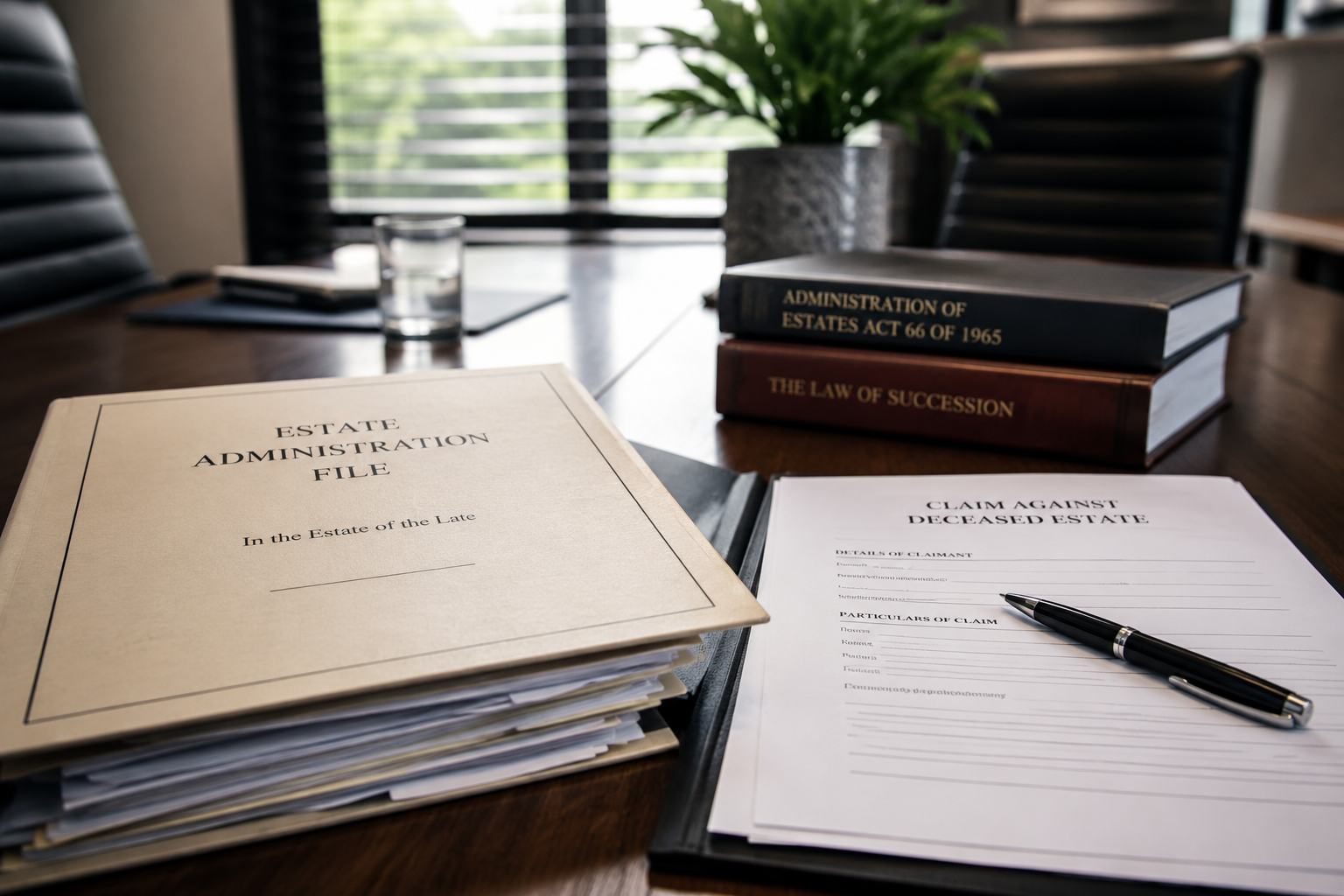
Disputed claims against a deceased estate can delay the administration of an estate, reduce what beneficiaries may receive, and place an executor in a difficult position. These disputes often arise when a creditor says the deceased owed money, a family member claims repayment of an informal loan, a maintenance-related claim is lodged, or beneficiaries believe that a claim is false, inflated or unsupported.
Disputed claims against a deceased estate are not all the same. Some involve ordinary creditor claims. Others involve informal family loans, alleged repayments, maintenance-related claims, or claims by heirs who say they are owed money in a capacity separate from their inheritance rights.
A claim against a deceased estate is not the same as a dispute about who should inherit. A creditor claim is based on an alleged legal obligation that existed before death, or a legally recognised obligation that may be enforceable against the estate. An inheritance dispute, by contrast, usually concerns the interpretation of a will, the validity of a will, or how the estate must be distributed under the will or the Intestate Succession Act.
Where disputed claims against a deceased estate affect payment, distribution or the liquidation and distribution account, early legal advice is often necessary. A claimant may need to prove the debt. A beneficiary may need to object to an unsupported claim. An executor may need to decide whether to accept, investigate, reject or formally dispute the claim.
Vermeulen Attorneys assists clients with deceased estates litigation, including disputes involving creditor claims, rejected claims, beneficiary objections and executor decision-making.
What Is a Claim Against a Deceased Estate?
A claim against a deceased estate is a claim that, in principle, could have been brought against the deceased during their lifetime or is otherwise legally enforceable against the estate after death. Common examples include unpaid loans, contractual debts, delictual claims, maintenance-related claims, unpaid professional fees, or amounts due under an agreement.
The key question in disputed claims against a deceased estate is whether the estate is legally liable for the claim. The fact that a person feels morally entitled to payment does not, on its own, make the claim enforceable. The claimant must be able to show a proper legal basis for the claim and must provide enough evidence to allow the executor to assess it.
This is why disputed claims against a deceased estate often turn on documents, timing and credibility. Written agreements, bank statements, invoices, acknowledgments of debt, correspondence, proof of payment and court orders may become central to the dispute.
How Creditor Claims Differ From Beneficiary Disputes
A creditor claim is made against the estate because the claimant says the estate owes them money or another legal performance. A beneficiary dispute usually concerns a person’s right to inherit from the estate.
This distinction matters in disputed claims against a deceased estate. Creditors are generally dealt with before heirs and beneficiaries receive distribution. If a valid creditor claim is admitted, it may reduce the residue available for beneficiaries. If a false or inflated claim is admitted, beneficiaries may suffer prejudice. If a valid claim is wrongly rejected, the claimant may need to take further legal steps.
Beneficiaries should therefore not assume that every claim against an estate is suspicious. Equally, executors should not admit claims simply because a person insists that money was owed. The executor must administer the estate properly and must treat disputed claims against a deceased estate with appropriate care.
Can an Heir Also Have a Claim Against the Estate?
An heir or beneficiary is not prevented from lodging a claim against a deceased estate merely because they may also stand to inherit. The important distinction is between the person’s inheritance position and the separate legal basis for the claim.
For example, a child of the deceased may be an heir under a will or under intestate succession, but may also allege that the deceased owed them money under a loan, agreement, reimbursement arrangement or another legally enforceable obligation. That claim must still be proved in the same way as any other claim against the estate.
In Ntuli v Brazington N.O [2025] ZAGPPHC 944, the High Court dealt with a claim against a deceased estate brought by an heir. The judgment is useful because it illustrates that the claimant’s status as an heir does not remove the need to prove a legally enforceable claim against the estate. The claim must still be assessed on its legal basis, the evidence supporting it, and whether it is properly enforceable against the estate.
This is a practical warning for all parties. Claimants should not assume that a family relationship or inheritance expectation proves the claim. Executors should not reject a claim simply because it comes from an heir. Beneficiaries should distinguish between opposing a suspicious claim and objecting merely because the claim may reduce what remains for distribution.
The Section 29 Notice and Lodging a Claim
Under section 29 of the Administration of Estates Act 66 of 1965, an executor must publish a notice calling on persons with claims against the estate to lodge those claims within the period stated in the notice. The notice is published in the Government Gazette and in relevant newspapers, depending on where the deceased ordinarily resided or owned property.
The period for lodging claims must be at least 30 days and not more than three months from the date of the latest publication of the notice. A creditor who believes that the deceased estate owes them money should act promptly once the estate is reported and the executor is appointed.
A claim should usually be lodged in writing with supporting documents. The claimant should not assume that a verbal explanation will be sufficient, especially where the executor or beneficiaries may later challenge the claim.
What Happens If a Claim Is Lodged Late?
Late claims against a deceased estate can create practical and legal difficulty. Section 31 of the Administration of Estates Act deals with claims lodged after the expiry of the section 29 period.
A late claimant may still attempt to lodge a claim, but the delay can have consequences. If the claimant cannot satisfy the Master that there was a reasonable excuse for the delay, the claimant may be liable for costs caused by the late lodging of the claim, including costs connected with reframing an account. A late claimant may also be unable to demand repayment from another claimant who has already been paid under a valid claim before the late claim was lodged.
This makes timing important. A creditor who delays may not necessarily lose every possible remedy immediately, but delay can weaken the position, increase costs and complicate distribution.
How an Executor Should Deal With Disputed Claims Against a Deceased Estate
An executor should not accept or reject disputed claims against a deceased estate without proper consideration. The executor must assess the legal basis for the claim, the available evidence, the estate’s financial position, and any objections raised by beneficiaries or other interested parties.
Section 32 of the Administration of Estates Act gives an executor tools to deal with disputed claims against a deceased estate. If the executor disputes a claim, the executor may require the claimant to lodge an affidavit setting out details of the claim. With the consent of the Master, the executor may also require the claimant or another person who may have material information to appear for examination under oath.
If a claimant fails without reasonable excuse to comply with a proper notice, refuses to take the oath, refuses to submit to examination, or fails to answer lawful questions fully and satisfactorily, the executor may reject the claim.
This procedure is important because it helps separate properly supported claims from claims that are vague, unsupported or unreliable. It also protects the executor from making a decision on insufficient information.
What If the Executor Rejects the Claim?
If an executor rejects a claim against the estate, section 33 of the Administration of Estates Act requires the executor to notify the claimant in writing by registered post and to state the reasons for rejecting the claim.
A rejected claim does not always end the matter. Depending on the facts, the claimant may need to consider litigation to prove the claim. If a court later finds in favour of the claimant, the court may still consider whether the executor was justified in rejecting the claim, especially if the claimant did not provide sufficient information when asked to do so.
A claimant whose claim has been rejected should obtain legal advice quickly. The next step may depend on the reason for rejection, the evidence available, the value of the claim, the stage of the estate administration and whether the liquidation and distribution account has already been prepared or advertised.
If you are facing a rejected claim, you can contact Vermeulen Attorneys through our Contact Us page for advice on the correct next step.
Can Beneficiaries Object to a Creditor Claim?
Beneficiaries may have a legitimate interest in disputed claims against a deceased estate because admitted creditor claims can reduce the inheritance available for distribution. A beneficiary may be concerned that a claim is fabricated, inflated, prescribed, unsupported, based on an informal family arrangement, or inconsistent with the deceased’s records.
A beneficiary should raise concerns clearly and with supporting reasons. It is usually more effective to identify the problem with the claim than simply to object because the claim reduces the inheritance. Useful objections may include that there is no written agreement, the alleged payments are not proved, the amount claimed does not reconcile with bank records, the claim appears to have been settled, or the claimant has not explained the legal basis for the claim.
Where the disputed claim has already been included in, excluded from, or incorrectly reflected in the liquidation and distribution account, the beneficiary may also need to consider objecting to a liquidation and distribution account.
What Evidence Is Usually Important?
The evidence required will depend on the nature of the claim. A formal bank loan, an unpaid invoice, an oral family loan and a maintenance-related claim will not all be proved in the same way.
In many disputed claims against a deceased estate, the following documents may be important:
- written loan agreements, acknowledgments of debt or contracts;
- bank statements showing payments made to or from the deceased;
- invoices, statements of account or proof of services rendered;
- WhatsApp messages, emails or letters confirming the debt;
- court orders or settlement agreements;
- proof that the amount remains unpaid;
- documents explaining how the amount claimed was calculated.
Informal family loans often create difficulty because the deceased is no longer available to confirm or deny the arrangement. In those cases, the surrounding evidence becomes important. Executors and beneficiaries should be cautious about accepting vague allegations without documentary support.
Common Risks in Disputed Claims Against a Deceased Estate
Several risks arise when disputed claims against a deceased estate are not dealt with properly. The main risk is that the estate may be distributed on the wrong basis: either by paying a claim that should not have been admitted, or by rejecting a claim that should have been properly recognised.
A valid claim may be ignored
If an executor ignores a valid claim, the claimant may suffer prejudice and the estate may be exposed to further proceedings. An executor who repeatedly ignores claims, refuses to communicate or acts with partiality may create concerns about executor misconduct in deceased estates.
A false or inflated claim may be admitted
If a claim is admitted without proper scrutiny, beneficiaries may receive less than they should. This is especially serious where the claim is based on an alleged verbal loan, undocumented services or a family arrangement that is disputed by other heirs.
The liquidation and distribution account may become contested
Once the disputed claim is reflected in the estate account, the dispute may move into the account-objection stage. Beneficiaries and claimants should then act within the correct procedural time periods.
The estate may be insolvent
If the estate cannot pay all valid claims, the executor must consider the estate’s solvency and the statutory process applicable to insolvent deceased estates. Creditors and beneficiaries should not assume that every admitted claim will be paid in full.
When Litigation May Be Necessary
Litigation may become necessary where the executor rejects a claim, where a claimant insists on a disputed debt, where beneficiaries object to the admission of a claim, or where the estate account cannot be finalised without resolving the dispute.
Not every disagreement should immediately become court litigation. Some disputes can be resolved by providing better documents, obtaining affidavits, narrowing the amount in dispute or engaging through attorneys. However, where the claim is substantial, unsupported, time-sensitive or likely to affect distribution, litigation advice should be obtained before rights are lost or the estate is distributed.
Beneficiaries who are unsure whether their issue is a creditor-claim dispute, an executor dispute or a broader estate dispute may also find it useful to read our guide to deceased estate disputes in South Africa.
What Creditors, Beneficiaries and Executors Should Do
Creditors should lodge claims promptly, in writing, and with supporting evidence. They should not wait until the estate account is almost finalised before taking action.
Beneficiaries should monitor claims that may reduce the estate and raise reasoned objections where a claim appears false, inflated or unsupported. They should also consider broader legal remedies for beneficiaries where the executor’s conduct or the estate administration creates prejudice.
Executors should keep proper records, request supporting documents where necessary, use section 32 procedures where appropriate, communicate decisions in writing, and obtain legal advice before accepting or rejecting a claim that may materially affect the estate.
Disputed claims against a deceased estate are often evidence-driven and time-sensitive. The safest approach is to address the issue before the liquidation and distribution account is finalised, before payments are made, and before the dispute becomes more expensive to correct.
Speak to Vermeulen Attorneys About a Disputed Estate Claim
If you are a creditor whose claim has been rejected, a beneficiary concerned about a suspicious claim, or an executor uncertain how to deal with a disputed claim, Vermeulen Attorneys can assist with practical legal advice and litigation strategy.
Our deceased-estates litigation team can help assess the claim, review the supporting documents, advise on objections, engage with the executor or Master, and advise whether court proceedings may be necessary.
Contact Vermeulen Attorneys to arrange a consultation about disputed claims against a deceased estate.
Frequently Asked Questions
What is a claim against a deceased estate?
A claim against a deceased estate is a claim that the deceased or the estate is legally liable to pay. It may arise from a loan, contract, delict, maintenance-related obligation or another enforceable legal basis. It is different from a beneficiary’s right to inherit.
Can an heir also claim against the deceased estate?
Yes. An heir may also have a separate claim against the estate if there is an independent legal basis for that claim. The person’s status as an heir does not prove the claim. The claim must still be supported by evidence and must be legally enforceable against the estate.
Can the executor reject my claim against the estate?
Yes. An executor may reject a claim if it is not legally valid, is not properly supported, or remains unproved after the executor has requested further information. If the executor rejects the claim, the executor must notify the claimant in writing and give reasons.
What can I do if the executor rejected my claim?
You should obtain legal advice quickly. Depending on the facts, you may need to provide further evidence, challenge the rejection, or institute proceedings to prove the claim. The correct step depends on the reason for rejection and the stage of the estate administration.
Can beneficiaries object to a creditor claim against the estate?
Yes. Beneficiaries may raise concerns where a claim appears false, inflated, unsupported or incorrectly reflected in the estate account. The objection should be based on facts and evidence, not merely on dissatisfaction that the claim may reduce the inheritance.
What happens if a claim against a deceased estate is lodged late?
A late claim may create cost and distribution consequences. The claimant may have to explain the delay to the Master and may be liable for costs caused by the late claim if there is no reasonable excuse. A late claimant may also be unable to recover money already paid to another claimant under a valid claim.
Do all disputed claims against a deceased estate go to court?
No. Some disputed claims against a deceased estate can be resolved through documents, affidavits, attorney correspondence or proper executor investigation. Court proceedings may be necessary where the claim remains disputed, has been rejected, materially affects distribution, or cannot be resolved through the estate administration process.