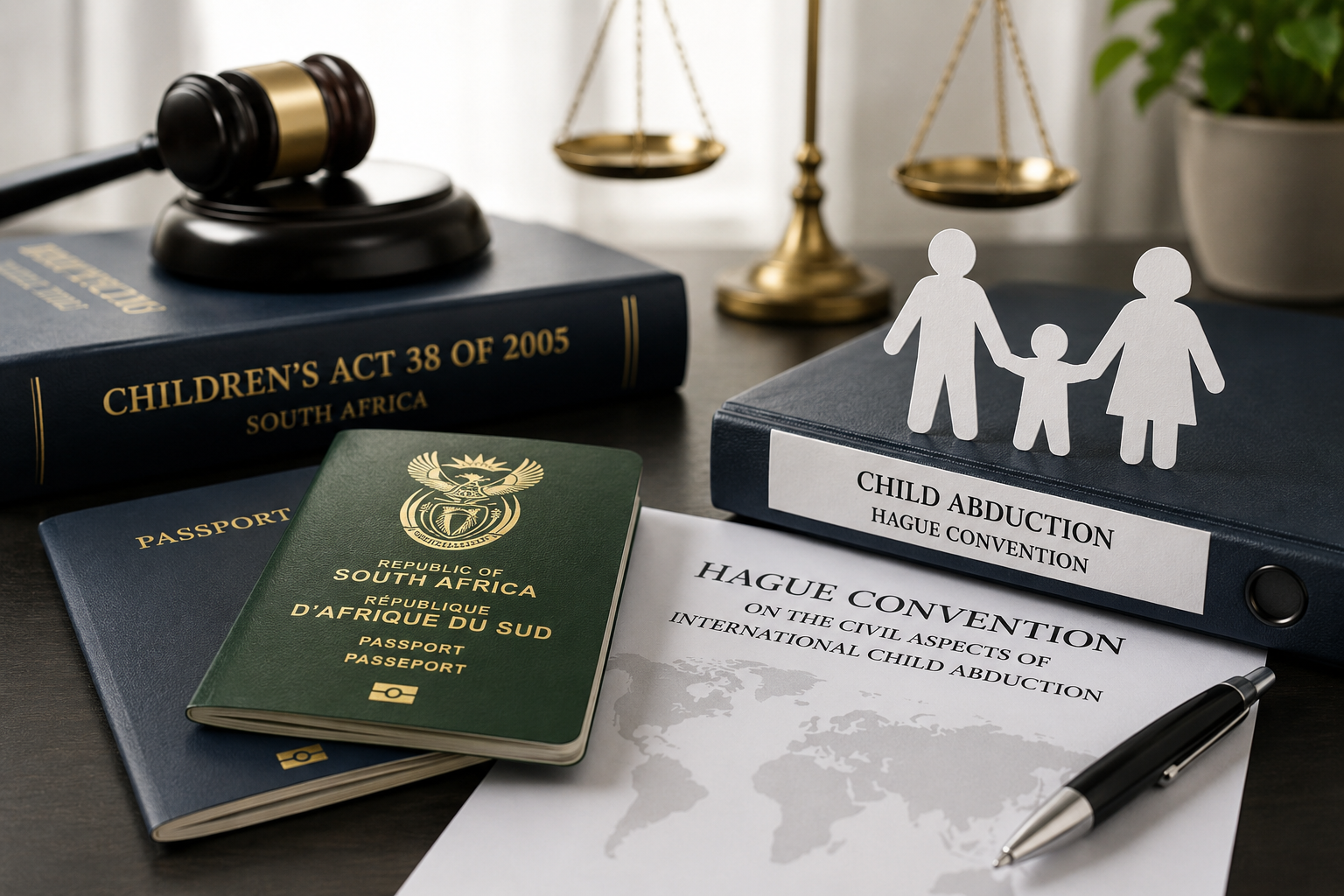
International travel consent in South Africa is an important legal issue for parents who share parental responsibilities and rights in respect of a minor child. A family holiday, overseas school tour, sports trip, wedding, or proposed relocation can quickly become complicated where one parent refuses to consent to the child leaving the Republic.
Under the Children’s Act 38 of 2005, guardianship includes the authority to give or refuse consent in respect of significant decisions affecting a child, including a child’s departure or removal from South Africa and a child’s application for a passport. Where both parents are guardians, both will ordinarily need to consent unless a court order provides otherwise.
This article explains when consent is required, why disputes arise, what parents should do if consent is refused, and when urgent court intervention may become necessary.
Understanding International Travel Consent South Africa
In South African family law, international travel by a minor child is not only a practical travel arrangement. It is also a guardianship issue.
Section 18 of the Children’s Act deals with parental responsibilities and rights. These include care, contact, guardianship and maintenance. Guardianship is particularly important in international travel matters because a guardian may be required to consent to major legal decisions affecting a child.
These decisions include:
- the child’s departure or removal from South Africa;
- the child’s application for a passport;
- the child’s adoption;
- the child’s marriage; and
- certain decisions relating to the child’s property interests.
Where more than one person holds guardianship in respect of a child, the consent of all guardians is generally required for these major decisions, unless a competent court orders otherwise.
Who Is a Guardian of a Minor Child?
Many international travel disputes begin because parents misunderstand the difference between care, contact and guardianship.
In many cases, married parents are both guardians of their minor children. Divorced parents also usually remain co-guardians unless a court order specifically changes that position. An unmarried father may acquire parental responsibilities and rights, including guardianship, where the requirements of the Children’s Act are met.
A parent who has primary care of a child does not automatically have the sole right to make international travel decisions. Similarly, a parent who exercises limited contact may still hold guardianship rights. This means that a parent should not assume that a parenting arrangement, informal agreement, or day-to-day care arrangement automatically removes the need for consent.
For broader assistance with disputes involving parental responsibilities and rights, care, contact and guardianship, see our Children’s Matters page.
Do Both Parents Need to Consent to a Child Leaving South Africa?
Where both parents are guardians, both parents will ordinarily need to consent to the child’s international travel. This applies whether the travel is for a short holiday, a school trip, a sporting event, a family visit, or another temporary purpose.
Consent is also usually required where a minor child applies for a South African passport. This overlaps with international travel because a passport application and the child’s departure from South Africa are both decisions requiring proper guardianship consent.
If you are dealing specifically with a passport issue, you can also read our related article on child passport applications in South Africa.
Why International Travel Disputes Commonly Arise
International travel disputes are often emotionally charged because they involve both parental rights and the safety of the child. Disputes commonly arise where:
- one parent fears that the child will not be returned to South Africa;
- there is a strained co-parenting relationship;
- a relocation dispute is already developing;
- one parent refuses consent as a means of control or retaliation;
- travel dates interfere with existing contact arrangements;
- the travelling parent has not provided proper travel details;
- there are concerns about the destination country, accommodation, or supervision; or
- one parent intends to move abroad permanently or indefinitely with the child.
The law seeks to balance the child’s best interests, the parental responsibilities and rights of both parents, and the need to prevent international child abduction or unlawful retention of children outside South Africa.
Can a Parent Refuse International Travel Consent?
Yes. A parent who holds guardianship may refuse consent. However, the refusal should be reasonable, child-focused and based on genuine concerns.
A parent should not refuse consent merely because the parties are divorced, separated, in conflict, or involved in unrelated disputes. A refusal based on anger, punishment, jealousy, or control may be challenged in court.
A refusal may be more likely to be viewed as reasonable where there are genuine concerns about:
- the risk that the child may not be returned to South Africa;
- unclear or incomplete travel arrangements;
- lack of return flights or confirmed accommodation;
- travel to a country where enforcement may be difficult;
- previous threats to relocate or retain the child abroad;
- the child’s health, safety or emotional wellbeing; or
- the impact of the proposed travel on the child’s schooling or relationship with the other parent.
The central question is whether the refusal is aligned with the child’s best interests.
What Happens If Consent Is Refused?
If consent is refused, the travelling parent may approach a court for appropriate relief. Depending on the facts, the court may be asked to authorise:
- the child’s temporary international travel;
- the child’s passport application;
- the signing of documents by a sheriff or another authorised person where a parent refuses to sign;
- safeguards to ensure the child’s return to South Africa; or
- relocation in suitable cases.
The court will consider the facts carefully. Relevant considerations may include:
- the purpose of the travel;
- the duration of the trip;
- the proposed destination;
- the child’s relationship with each parent;
- the existence of a parenting plan or court order;
- the travelling parent’s history of cooperation and transparency;
- whether there is a return ticket and clear itinerary;
- the likelihood that the child will return to South Africa;
- the child’s age, maturity and views, where appropriate; and
- the overall best interests of the child.
Section 28 of the Constitution and the Children’s Act require that the best interests of the child be treated as paramount in matters concerning the child.
Temporary International Travel vs Relocation
Parents often confuse temporary international travel with permanent relocation. The distinction is important.
Temporary international travel
Temporary travel usually refers to a defined trip where the child is expected to return to South Africa. Examples include:
- family holidays;
- school tours;
- sports tours;
- educational trips;
- visits to extended family abroad; or
- attendance at a wedding, funeral or family event.
In these cases, the court will often focus on whether the trip is legitimate, whether proper safeguards are in place, and whether the child will return.
Relocation
Relocation is different. It involves one parent seeking to move the child permanently or indefinitely to another province or country. International relocation disputes are among the most complex matters in family law because they may fundamentally alter the child’s relationship with the non-relocating parent.
Relocation matters may involve:
- detailed factual evidence;
- psychological or social work reports;
- input from the Office of the Family Advocate;
- schooling and educational considerations;
- financial planning;
- immigration and visa issues;
- long-term contact arrangements; and
- practical arrangements for travel, communication and costs.
Where a relocation dispute arises in the context of divorce or separation, legal advice should be obtained as early as possible. You can read more about cross-border family law issues on our International Divorce page.
Can a Parent Be Stopped at the Airport?
Potentially, yes. Where the necessary consent documents, passport documents or court orders are not in place, travel may be disrupted. In some cases, an airline may refuse boarding, immigration officials may require further documents, or urgent litigation may follow.
Parents should not leave travel consent issues until the day of departure. Even where the planned trip is legitimate, the absence of proper documentation may result in missed flights, financial loss and unnecessary distress for the child.
Section 139 of the Children’s Act also deals with the unlawful taking or sending of a child out of South Africa without the required consent or lawful authority. This reinforces the seriousness with which South African law treats the removal of children from the Republic.
Practical Tips: International Travel Consent South Africa
If you want to travel internationally with your child
- Request written consent well in advance.
- Provide full travel details, including dates, destination, accommodation and contact information.
- Share copies of flight bookings and the proposed itinerary.
- Confirm when and how the child will return to South Africa.
- Check that the child’s passport is valid.
- Avoid making last-minute demands for signatures.
- Communicate in a clear, calm and transparent manner.
- Consult an attorney early if conflict is likely.
If you are asked to consent to your child’s international travel
- Ask for full travel details before responding.
- Consider the request from the perspective of the child’s best interests.
- Raise genuine concerns promptly and in writing.
- Avoid refusing consent simply to punish or inconvenience the other parent.
- Keep your response reasonable and focused on the child.
- Seek legal advice urgently if there is a genuine risk that the child may not return.
When Is Urgent Legal Advice Needed regarding international travel consent South Africa?
International travel disputes can escalate quickly, particularly before school holidays, festive periods or pre-booked trips. Urgent legal advice may be necessary where:
- a parent refuses to sign travel or passport documents;
- flights are imminent;
- one parent threatens to remove the child without consent;
- there is a genuine risk of international child abduction;
- a passport application is being obstructed;
- a relocation dispute is developing; or
- a child has already been removed or retained outside South Africa.
Early legal advice often helps parents resolve disputes before urgent court proceedings become necessary. Where litigation cannot be avoided, proper preparation is critical.
Where the dispute is capable of resolution without immediate litigation, parents may also benefit from family mediation and ADR services, particularly where ongoing co-parenting communication needs to be preserved.
International travel, child passport and relocation disputes often require careful handling where cross-border family law issues arise. Mervyn Vermeulen is a Fellow of the International Academy of Family Lawyers, reflecting Vermeulen Attorneys’ experience in complex international family law matters.
For assistance with children’s matters, guardianship disputes, international travel consent, relocation disputes or urgent family law applications, contact our specialist family law team.
Contact us today to schedule a consultation.
Frequently Asked Questions About International Travel Consent South Africa
Do both parents need to consent to international travel from South Africa?
Generally, yes. Where both parents are guardians, both parents will ordinarily need to consent to a minor child leaving South Africa, unless a court order provides otherwise.
Can my ex refuse consent simply because we are divorced?
No. Divorce does not automatically remove guardianship rights, but it also does not justify an unreasonable refusal. Consent decisions must be guided by the child’s best interests.
Can I apply for my child’s passport without the other parent?
Usually not where both parents are guardians. Consent from all guardians is generally required for a minor child’s passport application unless a court order authorises otherwise.
What if the other parent cannot be found?
If a parent is absent, missing or cannot reasonably be located, the other parent may need to approach a court for an order authorising the passport application or international travel.
What if I fear my child will not be returned to South Africa?
You should seek urgent legal advice. A court may refuse travel, impose safeguards, require undertakings, or make another order designed to protect the child’s best interests.
Does a parenting plan override section 18 of the Children’s Act?
Not automatically. A parenting plan may regulate travel consent if properly drafted and made legally enforceable, but guardianship requirements and the wording of any court order must be considered carefully.
Can grandparents travel internationally with my child?
Yes, but proper consent from the child’s guardians will usually be required. Additional documents may also be necessary, depending on the circumstances and destination.
Is relocation treated differently from a holiday?
Yes. A holiday is usually temporary travel with an intended return date. Relocation involves a long-term or permanent move and is treated as a far more complex legal issue.
Can a court override a parent’s refusal to consent?
Yes. If a court finds that consent is being unreasonably withheld and that travel is in the child’s best interests, it may grant an order authorising the travel or passport application.
When should I speak to an attorney?
You should seek advice as soon as consent becomes uncertain, especially if travel dates are close, documents are being withheld, or there are concerns about abduction, relocation or non-return.