International Divorce Guide: South Africa (Free Download)
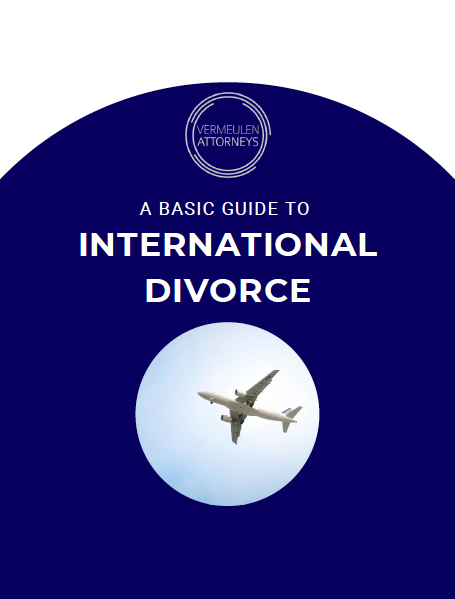
Dealing with divorce is never easy—especially when it spans multiple countries. That’s why Vermeulen Attorneys has created the International Divorce Guide. This free download is specifically designed for South Africans navigating divorce where one or both spouses live abroad, foreign laws apply, or cross-border parenting and maintenance disputes arise.
Why We Created the International Divorce Guide
International family law has become increasingly relevant. Our clients often ask: Can I get divorced in South Africa if I live in Dubai? What if my spouse refuses service overseas? What about custody if my child is taken abroad? Our International Divorce Guide addresses these scenarios and more—making it a useful resource for globally connected families.
What You’ll Learn in the Guide
- How to establish jurisdiction in South African courts
- What happens when you’re married under foreign matrimonial law
- How the Hague Convention applies to child abduction cases
- How to serve divorce papers abroad
- How to enforce orders internationally using mirror orders or Apostille certificates
- Consent requirements and legal strategies for international relocation with children
- Step-by-step practical tips to avoid costly mistakes
Who This International Divorce Guide Is For
If any of the following apply to you, this International Divorce Guide is essential:
- You live overseas and want to file for divorce in South Africa
- You were married under foreign law
- You’re dealing with cross-border parenting, child relocation, or maintenance enforcement
- Your spouse refuses to cooperate from another jurisdiction
How This Guide Helps You Take Control
Divorcing across jurisdictions doesn’t need to be a legal nightmare. This guide demystifies critical procedures like edictal citation, substituted service, and court jurisdiction. Whether you’re worried about cross-border family law or how to protect your rights abroad, this International Divorce Guide gives you clarity and next steps.
Download Your Free Copy
Download A Basic Guide to International Divorce and empower yourself with expert insights from the legal team at Vermeulen Attorneys.
Why Trust Vermeulen Attorneys?
We are a specialist family law firm with offices in Roodepoort and Ballito. Our team has successfully handled dozens of international divorces—helping South Africans living abroad, dealing with the Hague Convention, and resolving complex divorce across jurisdictions. We are also pioneers in mediation and collaborative law strategies for global families.
Need Advice Now?
Book a consultation online at vermeulenlaw.co.za or call 010 109 1089. We offer virtual and in-person consultations. Whether it’s custody, maintenance, or enforcement, we’re here to help.
Download the International Divorce Guide Now
📘 Download the Guide (Free PDF)
Introduction
In an increasingly globalised world, families often span multiple jurisdictions. South African citizens marry abroad, foreign nationals settle in South Africa, and children move across borders with their parents. These realities give rise to complex legal questions when family relationships break down. International family law has emerged as a critical field to address these challenges.
This International Divorce Guide has been developed to assist individuals navigating international divorce, parenting disputes, maintenance enforcement, and child relocation across borders. It is designed specifically for those who either reside in South Africa or have a legal or familial connection to South Africa, but are involved in family law disputes with an international dimension.
Why International Family Law Requires Specialised Attention
Domestic family law principles do not always provide clear answers when:
- One or both parties reside abroad
- Children have been removed from South Africa or live in another country
- The couple is married under a foreign matrimonial property regime
- A parent seeks to relocate with a child internationally
- A maintenance order must be enforced in or outside South Africa
These situations require a careful legal navigation of South African legislation alongside international treaties, foreign laws, and cross-border procedures.
How This Guide Will Help
This guide provides a practical overview of:
- Who can get divorced in South Africa where one or both spouses live abroad
- How foreign marriage regimes and matrimonial property are treated legally
- Key principles of the Hague Convention on child abduction and relocation
- Enforcement of maintenance orders through international frameworks
- The impact of international treaties such as the UN Convention on the Rights of the Child
Each section concludes with guidance on when to seek legal advice and how Vermeulen Attorneys can help resolve your matter efficiently and lawfully.
What Is an International Divorce?
An international divorce occurs when a marital relationship is dissolved through a legal process involving two or more countries. This may be due to:
- One or both spouses living outside South Africa
- The spouses being citizens or residents of different countries
- The couple being married under a foreign legal system
International divorces often involve complex issues of jurisdiction, enforcement, and foreign laws.
Common Scenarios
- One spouse resides in South Africa, the other abroad
- Both spouses live abroad but retain ties to South Africa
- Foreign nationals living in South Africa seek divorce locally
Why International Divorce Is Legally Distinct
International divorces involve:
- Jurisdictional complexity – whether South African courts may entertain the action
- Conflict of laws – different countries may assign different rights and duties
- Procedural challenges – e.g. serving documents abroad
- Enforcement hurdles – ensuring SA orders are recognised elsewhere
When Is It Appropriate to Use the South African Courts?
SA courts can be used if one or both spouses:
- Are domiciled in South Africa
- Or have been ordinarily resident in South Africa for at least one year before initiating divorce
These jurisdictional requirements are explained in more detail in the following section.
Who Can Get Divorced in South Africa?
Determining whether South African courts have jurisdiction is the critical starting point. This is governed by Section 2(1) of the Divorce Act 70 of 1979, read with the Domicile Act 3 of 1992.
Jurisdictional Grounds
A South African court may hear a divorce if either party is:
- Domiciled in the court’s jurisdiction at the time of initiating the divorce
- Ordinarily resident in the jurisdiction and has lived in South Africa for at least one year before filing
Understanding Domicile
Domicile of Origin: Acquired at birth and remains unless replaced by a domicile of choice.
Domicile of Choice: As per Section 1(2) of the Domicile Act, a person lawfully present in a place with the intention to settle there for an indefinite period.
Examples of how domicile impacts jurisdiction include factors such as intention to return, visas, property ownership, and residency plans.
Practical Examples
- Example 1: One party remains in South Africa while the other moves abroad but intends to return – SA courts likely have jurisdiction.
- Example 2: Both parties live in SA but were married abroad – SA courts still have jurisdiction due to residency.
- Example 3: Both parties now live abroad with no SA domicile – SA courts may not have jurisdiction.
What If You Were Married Under Foreign Law?
The location of the marriage ceremony does not prevent South African courts from granting a divorce. Jurisdiction is based on domicile or residency—not where the marriage was celebrated.
Foreign Matrimonial Property Regimes
Asset division is based on the lex domicilii matrimonii – the law of the country where the husband was domiciled when the marriage took place. This is subject to valid antenuptial contracts.
Examples:
- If the husband was domiciled in England – English matrimonial law applies.
- If domiciled in South Africa – SA laws apply unless excluded by contract.
Case Law Confirming This Principle
- Frankel’s Estate v The Master 1950 (1) SA 220 (A)
- Sperling v Sperling 1975 (3) SA 707 (A)
Consequences of Applying Foreign Law
If foreign law applies, SA courts will consider that country’s laws on:
- Ownership of marital property
- Spousal maintenance
- Redistribution claims
- Recognition of foreign contracts
This may require expert testimony and increase the complexity and cost of proceedings.
Gender Equality and Future Reform
Critics argue the lex domicilii matrimonii principle can perpetuate gender inequality by focusing on the husband’s domicile. Although reform is anticipated, it remains binding law at the time of publication.
Service of Divorce Documents Abroad
Serving legal documents internationally presents unique procedural challenges. In South Africa, personal service is generally required, even if the defendant lives overseas.
Personal Service: The General Rule
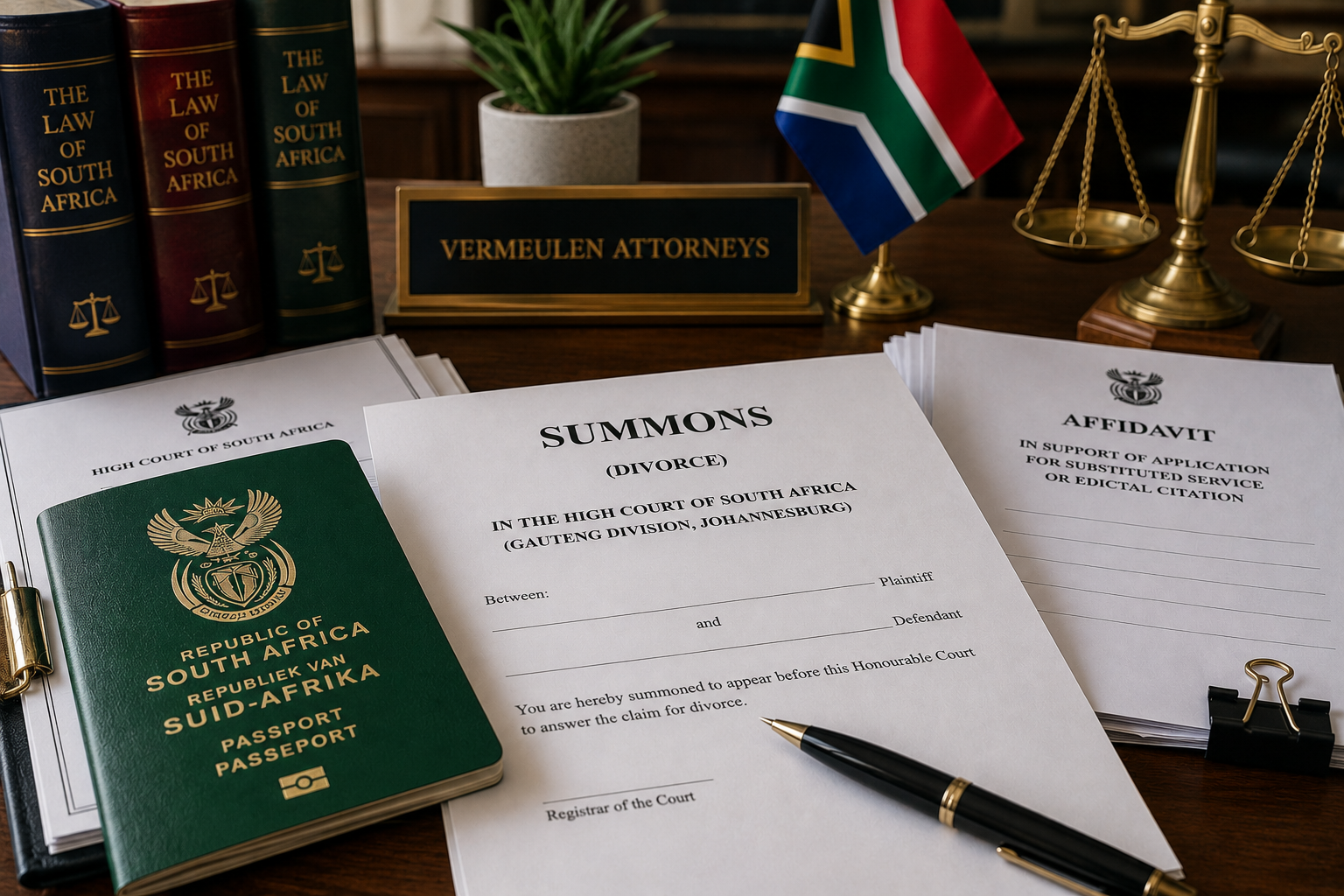
Divorce summons must be personally served due to the nature of the legal status change. If abroad, special court approval is needed for service outside the Republic.
Edictal Citation and Substituted Service
South African law allows for alternative methods of service where personal delivery is not possible:
Edictal Citation
- Foreign sheriff or court official
- Embassy or consulate
- International courier
Substituted Service
- Social media (with court permission)
- Fax or similar methods
Applications must be supported by an affidavit showing why normal service is impractical, details of the defendant’s whereabouts, and proposed alternatives.
Step-by-Step Overview
- Draft affidavit requesting edictal/substituted service
- Launch a motion application
- Appear in court (usually in chambers)
- Receive a court order specifying how to serve
- Effect service as directed
- File proof of service to place on the roll
Enforcement of Divorce and Related Orders Internationally
Securing a South African order is only half the battle—enforcing it abroad involves more legal layers.
Cross-Border Enforcement Challenges
Key considerations include:
- Will foreign courts recognise the SA divorce?
- Can maintenance or parenting orders be enforced?
- Does the foreign country follow public policy or treaty recognition?
The Hague Convention on International Child Abduction
South Africa is a party to the 1980 Hague Convention. This governs:
- Return of children wrongfully removed/retained
- Access arrangements across borders
Applications are handled by the Chief Family Advocate as the Central Authority.
The Apostille Convention
This treaty removes the need for legalisation of documents used internationally. Apostille certificates are issued by DIRCO or High Court officials and confirm the authenticity of SA court documents.
Private International Law Enforcement
In the absence of treaties, enforcement may occur via:
- Mirror orders in foreign courts
- Civil enforcement actions
- Domestic recognition in the target country
International Relocation with Children
Relocation occurs when a parent or guardian seeks to move permanently from South Africa with a minor child. This is governed by Section 18(3)(c)(iii) of the Children’s Act 38 of 2005.
The Legal Framework
Consent is required from:
- All guardians
- Anyone with rights of care/contact
- The child (if mature enough)
Without consent, a High Court application is needed, where the child’s best interests are the primary focus.
Relocation With Consent
- Sign a consent agreement and make it a court order
- Amend parenting plans to cover visits and communication
- Obtain a mirror order in the new country for enforcement
Relocation Without Consent
The relocating parent must show that the move serves the child’s best interests. Courts will examine:
- Parent-child relationships
- Reasons for the move
- Impact on the child’s development and stability
Loss of Jurisdiction
If a child is removed without court approval, South African courts may lose jurisdiction over parental rights and disputes. This complicates enforcement unless the foreign country recognises SA orders.
Practical Planning
- Engage the other parent early
- Use mediation where possible
- Draft detailed parenting plans
- Seek legal advice on mirror orders and treaty enforcement
Practical Tips for Parties Facing an International Divorce
1. Maintain or Establish Jurisdiction Early
If you intend to file in South Africa, ensure that you or your spouse is domiciled or has been ordinarily resident for the required period. Extended time abroad may shift jurisdiction unintentionally.
2. Identify the Applicable Matrimonial Property Regime
Determine the husband’s domicile at the time of marriage to assess the governing law. If foreign law applies, expert legal opinions may be necessary—and costly.
3. Plan Ahead for Service of Documents
Check whether service abroad requires edictal citation or substituted service. Budget for court applications, time delays, and translations.
4. Consider Enforcement From the Outset
Ask whether the other country is party to a reciprocal enforcement agreement. Include enforcement clauses in settlement agreements where possible.
5. Think Beyond the Divorce Order
Plan for post-divorce parenting arrangements, mirror orders, and international contact. Consider education, retirement, and mobility needs.
6. Use Legal Experts in Both Jurisdictions
Where appropriate, instruct attorneys in both South Africa and the foreign jurisdiction to ensure proper planning and enforcement.
7. Do Not Delay
Time is critical, especially when urgent court relief is required or a child has been wrongfully removed. Early legal advice prevents costly errors.
Frequently Asked Questions (FAQs)
1. Can I get divorced in South Africa if my spouse is overseas?
Yes, if you are domiciled or have been ordinarily resident in South Africa for at least one year prior to filing. Both parties do not need to be in the country.
2. Do I need to return to South Africa to get divorced here?
No, not always. If you are domiciled in South Africa, you can start the process remotely. In some contested matters, physical court appearance may be required.
3. What happens if my spouse refuses to accept service of documents abroad?
You can apply for edictal citation or substituted service, allowing for alternatives like email, WhatsApp, or courier, subject to court approval.
4. Does it matter where I was married?
No. The location of the marriage is irrelevant if South African jurisdiction is properly established through domicile or residence.
5. What if my spouse and I live in different countries?
If one of you is domiciled or ordinarily resident in South Africa, local courts may still have jurisdiction. If not, another forum must be found.
6. Will my South African divorce order be recognised abroad?
Recognition depends on foreign law. Apostilling or registering the order locally is often required. Legal advice in that country is advised.
7. Can we settle everything even if we live in different countries?
Yes. Attorneys can draft and finalise settlement agreements remotely, including via electronic signatures. These can be made court orders.
8. How do I claim maintenance from someone living overseas?
You can apply under the Reciprocal Enforcement of Maintenance Orders Act if they live in a proclaimed country. The order is sent through diplomatic channels.
9. Can my child be relocated abroad without my consent?
No. Consent or a High Court order is required. Removing a child without consent may trigger proceedings under the Hague Convention.
10. What is a mirror order, and why is it important?
A mirror order is a foreign court order replicating the South African parenting plan. It ensures enforceability in the new country.
11. What countries does the International Divorce Guide apply to?
The international divorce guide is tailored to South African law but applies to divorces involving countries with ties to South African residents, including reciprocal enforcement nations.
12. Does the International Divorce Guide help with registering foreign divorce orders?
Yes. The international divorce guide explains how to have a foreign divorce recognised in South Africa and includes steps for cross-border family law compliance.
13. Is the International Divorce Guide suitable for same-sex international divorces?
Absolutely. The international divorce guide covers diverse family structures and applies to same-sex couples seeking divorce across jurisdictions.
14. Can I use the International Divorce Guide to prepare documents for court?
While not a substitute for legal advice, the international divorce guide outlines key documents, court forms, and filing processes for South African international divorce cases.
15. Will the International Divorce Guide explain mirror orders?
Yes. The international divorce guide covers mirror orders to help enforce SA parenting plans abroad, vital in cross-border family law disputes.
16. Does the International Divorce Guide discuss enforcement under the Hague Convention?
Definitely. The international divorce guide explains the Hague Convention South Africa’s role in international child abduction and access rights enforcement.
17. Can I find information on how to serve divorce papers internationally in this guide?
Yes. The international divorce guide provides practical guidance on how to serve divorce papers internationally, including edictal citation and substituted service methods.
18. What if my international divorce involves a foreign trust or estate?
The international divorce guide briefly discusses international property structures and how foreign matrimonial regimes affect asset division across jurisdictions.
19. Is mediation addressed in the International Divorce Guide?
Yes. The international divorce guide promotes mediation and collaborative strategies for resolving international divorces and cross-border family law matters.
20. How do I get started with the International Divorce Guide?
Simply download the international divorce guide here and begin understanding your legal options with confidence and clarity.
Final Thoughts and Professional Guidance
International divorce requires an understanding of South African legal principles and foreign systems. Whether you’re:
- Living abroad and unsure if you can divorce in SA
- Married under a foreign property regime
- Trying to relocate with your child
- Needing to enforce an order overseas
- Concerned about child abduction or Hague proceedings
…you need advice from attorneys who understand international family law.
Why Contact Vermeulen Attorneys?
- We represent South Africans abroad
- We advise on cross-border divorce settlements
- We litigate and mediate relocation and custody issues
- We work with Central Authorities and treaty bodies
- We handle international enforcement with discretion and care
Contact Us Today
📞 Telephone: 010 109 1089
🌐 Website: www.vermeulenlaw.co.za
📍 Offices: Roodepoort & Ballito
💻 Consultations: In person or via MS Teams
This guide is for educational purposes only and does not constitute legal advice. For personalised assistance, contact Vermeulen Attorneys directly.