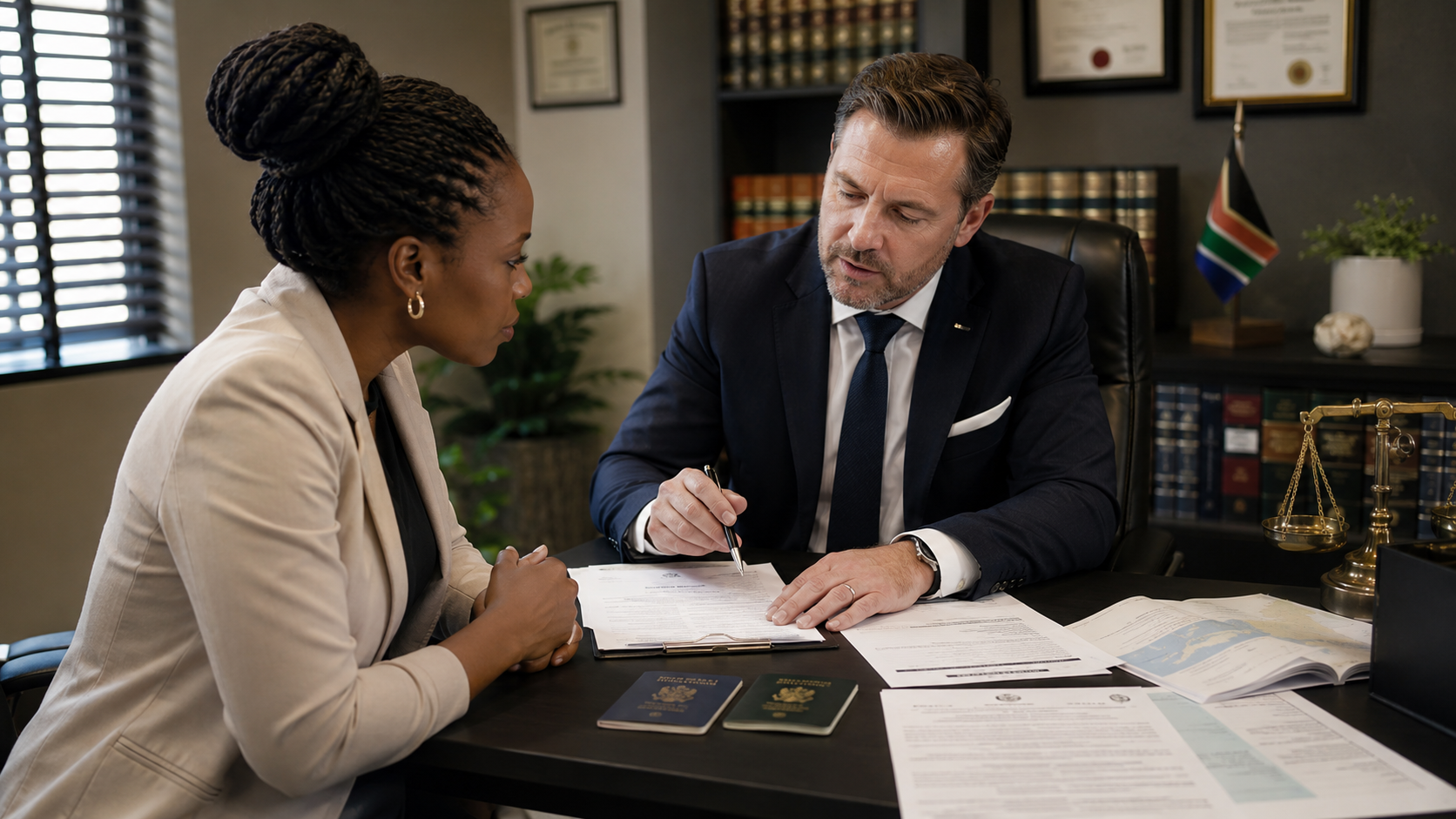
An international divorce in South Africa can become legally complex where one spouse lives overseas, the marriage was concluded in another country, assets are located in different jurisdictions, or children may relocate internationally after divorce.
South African courts may deal with divorce proceedings where the jurisdictional requirements in the Divorce Act 70 of 1979 are met. Where children are involved, section 28 of the Constitution and the Children’s Act 38 of 2005 require that the child’s best interests remain paramount.
This guide answers 10 common questions about international divorce in South Africa and explains when legal advice is necessary.
1. Can I Get Divorced in South Africa If My Spouse Lives Overseas?
Yes. You may be able to get divorced in South Africa even if your spouse lives in another country, provided the South African court has jurisdiction.
In general, a South African court may have jurisdiction if one or both spouses:
- are domiciled within the court’s area of jurisdiction when the divorce proceedings are instituted; or
- are ordinarily resident within the court’s area of jurisdiction and have been ordinarily resident in South Africa for at least one year before the divorce is instituted.
If your spouse lives overseas, the divorce papers must still be served properly. This may require service outside South Africa through the correct court procedure, often referred to as edictal citation or substituted service, depending on the circumstances.
Vermeulen Attorneys assists clients with international divorce in South Africa, including matters where one spouse is abroad.
2. Which Country Should I File for Divorce In?
The correct country depends on jurisdiction, convenience, enforceability, costs, urgency, children’s arrangements, and where the assets are located.
Important questions include:
- Where do the spouses live?
- Where are they domiciled?
- Where are the children living?
- Where are the main assets situated?
- Which country’s court can grant effective relief?
- Will the divorce order be recognised or enforceable in another country?
There is no single answer that applies to every international divorce. Filing in the wrong country can cause delay, unnecessary legal costs, or enforcement problems later.
3. Will South Africa Recognise My Foreign Divorce?
South Africa may recognise a foreign divorce, but recognition is not always automatic in every practical context.
A foreign divorce order may need to be considered in relation to:
- whether the foreign court had proper jurisdiction;
- whether the divorce order is final;
- whether both parties were treated fairly in the foreign proceedings;
- whether the order conflicts with South African public policy;
- whether the order must be used for Home Affairs, remarriage, property, pension, or child-related purposes.
Where there is uncertainty, legal advice should be obtained before relying on a foreign divorce order in South Africa. This is especially important if the foreign order affects children, immovable property, retirement benefits, or maintenance.
4. What Happens If My Spouse Refuses to Cooperate from Another Country?
A spouse cannot usually prevent a divorce simply by refusing to cooperate or by living overseas.
If your spouse refuses to engage, ignores correspondence, or avoids service, your attorney may need to approach the court for directions on how the summons should be served. Once proper service has taken place, the divorce may proceed in accordance with the applicable court rules.
If the spouse does not defend the divorce after proper service, the matter may proceed on an undefended basis. However, where children, maintenance, or assets are involved, the court will still need to be satisfied that the proposed relief is lawful and appropriate.
5. How Are Overseas Assets Divided in an International Divorce?
Overseas assets can complicate a divorce because South African courts may grant orders affecting the spouses personally, but enforcement in another country may require additional steps.
Important considerations include:
- the matrimonial property regime applicable to the marriage;
- whether there is an antenuptial contract or foreign marriage contract;
- where the assets are situated;
- whether the assets are movable or immovable property;
- whether foreign law affects ownership or enforcement;
- whether the foreign country will recognise or enforce a South African order.
Where significant international assets are involved, legal advice should be obtained before settlement negotiations begin. A poorly drafted settlement agreement may be difficult to enforce abroad.
6. Which Country’s Law Applies to the Marriage?
The law applicable to a marriage depends on the legal issue being considered. Different rules may apply to divorce jurisdiction, the validity of the marriage, property consequences, maintenance, pension interests, and parental responsibilities.
In South African divorce proceedings, the court will apply South African divorce law where it has jurisdiction to dissolve the marriage. However, foreign law may become relevant where:
- the marriage was concluded abroad;
- the spouses signed a foreign marriage contract;
- assets are located outside South Africa;
- one spouse argues that a foreign matrimonial property regime applies;
- a foreign court has already made an order.
This is one of the most technical areas of international divorce and should be assessed before issuing proceedings.
7. Can I Relocate Internationally With My Child After Divorce?
Not without proper consent or a court order. International relocation with a child after divorce is a serious legal issue.
Where both parents hold guardianship or parental responsibilities and rights, the relocating parent will usually need the other parent’s consent before permanently removing the child from South Africa. If consent is refused, the relocating parent may need to apply to court for permission.
The court will consider the child’s best interests, including:
- the reason for the relocation;
- the child’s relationship with each parent;
- the proposed living arrangements abroad;
- schooling, healthcare, and emotional stability;
- contact arrangements with the parent remaining in South Africa;
- whether the relocation plan is practical and child-focused.
Vermeulen Attorneys assists with emigrating with minor children and relocation disputes involving children.
8. Can My Spouse Take My Child Overseas Without My Consent?
If a parent removes a child from South Africa without the necessary consent or a court order, this may amount to unlawful removal or parental child abduction.
The Children’s Act gives effect to the Hague Convention on the Civil Aspects of International Child Abduction in South Africa. The purpose of the Hague Convention process is generally to secure the prompt return of a child who has been wrongfully removed or retained across international borders.
If there is a risk that a child may be removed from South Africa without consent, urgent legal advice should be obtained immediately.
Vermeulen Attorneys assists clients with Hague Convention child abduction matters.
9. Can Maintenance Be Claimed If One Spouse Lives Overseas?
Yes. Maintenance may still be relevant where one spouse or parent lives overseas, but enforcement can be more difficult if the person against whom maintenance is claimed is outside South Africa.
Maintenance issues in an international divorce may include:
- spousal maintenance;
- child maintenance;
- foreign income and exchange rates;
- proof of overseas earnings;
- enforcement of maintenance orders in another country;
- reciprocal enforcement where applicable.
Where children are involved, maintenance must be approached from the child’s needs and the parents’ respective financial means. Vermeulen Attorneys assists with child maintenance disputes, including matters with cross-border elements.
10. Do I Need a South African Attorney for an International Divorce?
You should obtain South African legal advice if:
- you live in South Africa and your spouse lives overseas;
- you live overseas but want to divorce in South Africa;
- your marriage was concluded in another country;
- you own assets in more than one country;
- your spouse has started divorce proceedings abroad;
- children may relocate internationally;
- there is a dispute about jurisdiction or foreign law;
- you need a South African divorce order to be recognised abroad.
International divorce matters require careful planning. The first procedural decision can affect cost, timing, children’s arrangements, asset division, and enforceability.
International Divorce and Mediation
Not every international divorce needs to become heavily contested litigation. Where both spouses are willing to engage constructively, mediation may assist in resolving parenting, maintenance, relocation, and property issues.
In High Court litigation, Rule 41A of the Uniform Rules of Court requires parties to consider mediation. In cross-border family matters, mediation can be especially useful where long-term co-parenting across countries is required.
Where appropriate, parties may also consider family mediation services before or during litigation.
Frequently Asked Questions About International Divorce in South Africa
Can I divorce in South Africa if I got married overseas?
Yes, provided the South African court has jurisdiction and the marriage is legally recognised. The fact that the marriage took place abroad does not automatically prevent a South African divorce.
Can I start divorce proceedings in South Africa while living overseas?
Possibly. This depends on domicile, ordinary residence, and whether the South African court has jurisdiction. Legal advice should be obtained before issuing summons.
How do I serve divorce papers on a spouse in another country?
Service outside South Africa usually requires the correct procedural steps, which may include court-authorised service abroad. The method depends on the country involved and the facts of the matter.
Can I get divorced if I do not know where my spouse lives overseas?
Possibly. If your spouse’s whereabouts are unknown, your attorney may need to apply to court for permission to serve the divorce papers by an alternative method.
Will a South African divorce order be accepted overseas?
It depends on the foreign country’s law. Some countries may recognise the order readily, while others may require registration, authentication, apostille, or separate recognition proceedings.
Can a South African court divide property in another country?
A South African court may make orders between the spouses, but enforcement against property located abroad may require foreign legal steps. This should be considered before settlement.
Can I relocate overseas with my child after divorce?
You generally need the other parent’s consent or a court order if both parents have guardianship or parental responsibilities and rights. The child’s best interests will be the central consideration.
What if my spouse starts divorce proceedings overseas first?
You should obtain urgent legal advice. There may be competing jurisdiction issues, and decisions taken early can affect the outcome of the divorce.
Does South African law apply if we were married in community of property overseas?
This depends on the validity of the marriage, the applicable matrimonial property regime, any marriage contract, domicile, and conflict-of-law principles. It must be assessed on the facts.
Can international divorce be settled by agreement?
Yes. Many international divorces are resolved by settlement agreement, provided the agreement is carefully drafted and enforceable in the relevant jurisdictions.
Speak to Vermeulen Attorneys About International Divorce in South Africa
An international divorce in South Africa requires careful legal planning, especially where overseas service, foreign assets, child relocation, maintenance, or foreign divorce recognition is involved.
Vermeulen Attorneys can assist with jurisdiction advice, divorce proceedings, cross-border parenting disputes, settlement agreements, relocation applications, and Hague Convention matters.