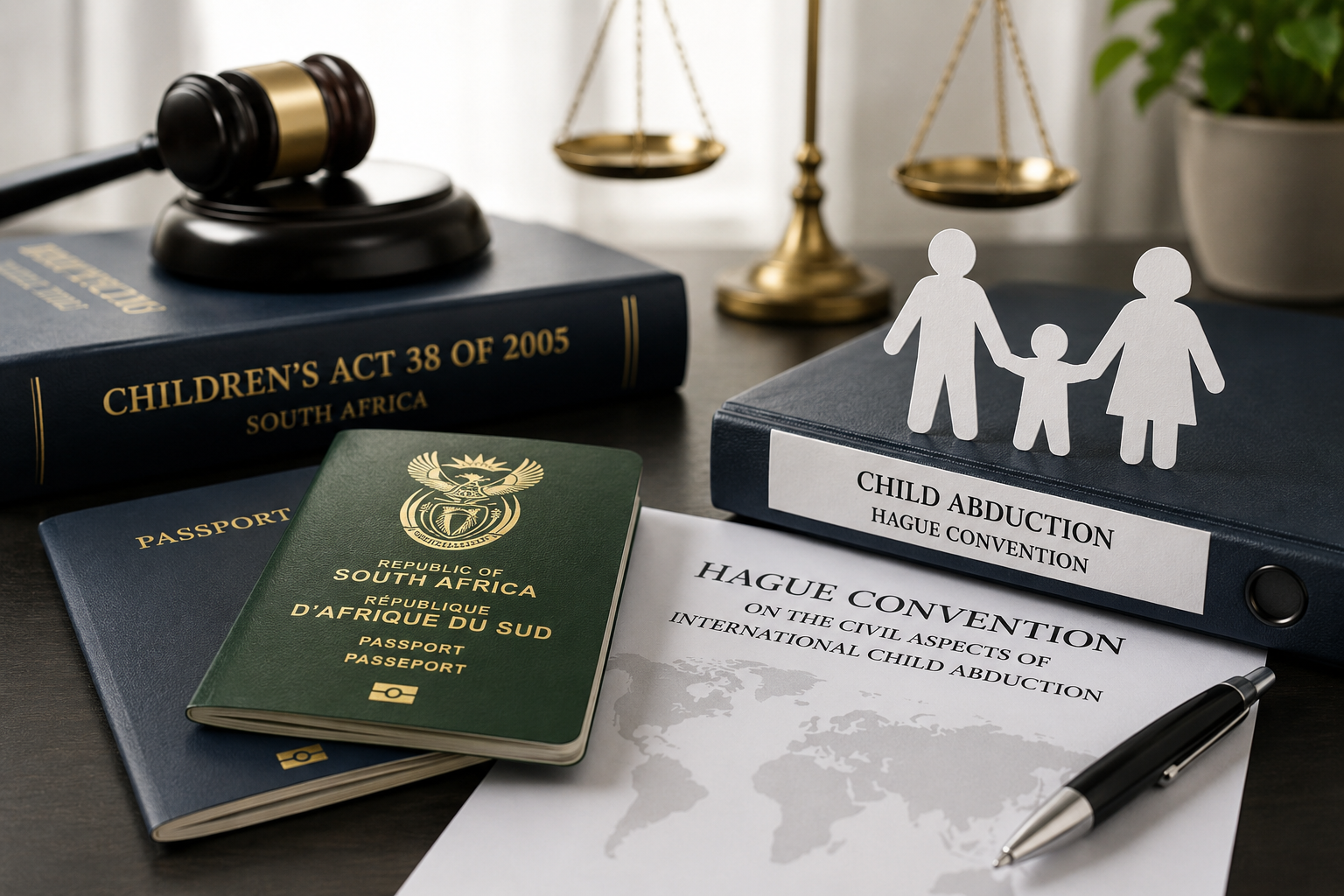
Hague Convention child abduction South Africa matters are among the most urgent and emotionally difficult disputes in family law. These cases usually arise where a child is removed from one country to another, or retained in another country, without the required consent of a parent or guardian.
South Africa is a party to the Hague Convention on the Civil Aspects of International Child Abduction. In South African law, the Convention is given force through Chapter 17 of the Children’s Act 38 of 2005, which specifically aims to give effect to the Convention and combat parental child abduction.
These matters often involve urgent High Court proceedings, international cooperation, parental responsibilities and rights, and the constitutional principle that a child’s best interests are of paramount importance in every matter concerning the child.
If your child has been removed from South Africa, retained overseas, or brought to South Africa without proper consent, urgent legal advice is essential. Vermeulen Attorneys assists clients with Hague Convention child abduction matters, children’s matters, and broader family law disputes.
1. What Is the Hague Convention on International Child Abduction?
The Hague Convention on the Civil Aspects of International Child Abduction is an international treaty designed to secure the prompt return of children who have been wrongfully removed from, or retained outside, their country of habitual residence.
The Convention does not decide which parent should have primary care, contact, or long-term decision-making authority. Its purpose is to ensure that those issues are decided by the courts of the country where the child was habitually resident before the alleged abduction.
In South Africa, section 275 of the Children’s Act provides that the Hague Convention on International Child Abduction is in force in the Republic and that its provisions are law in South Africa, subject to the Children’s Act.
2. What Qualifies as International Child Abduction in South Africa?
International child abduction usually occurs in one of two ways:
- Wrongful removal: where a child is taken from their country of habitual residence without the required consent or legal authority; or
- Wrongful retention: where a child is kept in another country after an agreed visit, holiday, or temporary arrangement has expired.
In Hague Convention matters, the focus is not simply whether a parent is unhappy with the child’s location. The court considers whether the removal or retention breached rights of custody or parental responsibilities and rights that were being exercised at the relevant time.
3. Is South Africa a Hague Convention Country?
Yes. South Africa is a Hague Convention country for international child abduction matters.
Chapter 17 of the Children’s Act deals specifically with child abduction. Section 274 states that the purpose of the chapter is to give effect to the Hague Convention on International Child Abduction and to combat parental child abduction.
The Hague Convention text is also included in Schedule 2 to the Children’s Act. This makes the Convention central to the way South African courts deal with cross-border child abduction disputes.
4. Who Is the Central Authority for Hague Convention Matters in South Africa?
The Chief Family Advocate is South Africa’s Central Authority for Hague Convention child abduction matters.
Section 276 of the Children’s Act provides that, in relation to South Africa, the Central Authority means the Chief Family Advocate appointed by the Minister of Justice and Constitutional Development. The Chief Family Advocate performs the functions assigned to Central Authorities under the Convention.
The Central Authority may assist with:
- receiving and processing Hague Convention applications;
- liaising with foreign Central Authorities;
- assisting in locating a child;
- facilitating information exchange between countries; and
- supporting the legal process for return applications.
Although the Central Authority plays an important role, Hague Convention matters frequently require urgent advice from attorneys experienced in High Court litigation and international family law.
5. What Does “Habitual Residence” Mean in Hague Convention Child Abduction South Africa Cases?
Habitual residence refers to the country where the child was ordinarily living before the alleged wrongful removal or retention.
This is one of the most important issues in Hague Convention child abduction South Africa cases because the Convention is based on returning the child to the country of habitual residence, unless a recognised exception applies.
Habitual residence is a factual enquiry. The court may consider factors such as:
- where the child lived before the removal or retention;
- where the child attended school or nursery;
- the child’s family and social environment;
- the parents’ intentions regarding relocation or temporary travel;
- the duration and purpose of the child’s stay in each country; and
- whether the child had become integrated into a particular country.
Habitual residence is not always the same as nationality, citizenship, or the country where one parent prefers the child to live.
6. Does the Hague Convention Decide Care and Contact Disputes?
No. A Hague Convention return application does not decide the final care and contact arrangements for the child.
The South African court’s task is usually to decide whether the child should be returned to the country of habitual residence so that the courts of that country can decide long-term parenting issues.
This distinction is important. A parent opposing return should not treat the Hague proceedings as a full custody dispute. The court will generally focus on the Convention requirements, the circumstances of the removal or retention, any recognised defences, and the child’s best interests within the Hague framework.
7. Can a Parent Oppose a Hague Convention Return Application?
Yes. A parent may oppose a Hague Convention return application, but the available defences are limited.
Depending on the facts, possible grounds of opposition may include:
- the left-behind parent consented to or later acquiesced in the removal or retention;
- there is a grave risk that return would expose the child to physical or psychological harm or place the child in an intolerable situation;
- the child objects to being returned and is of sufficient age and maturity for the court to take that objection into account;
- the application was brought after a significant delay and the child is now settled in the new environment; or
- the removal or retention was not wrongful under the Convention.
These defences are fact-specific and must be properly supported by evidence. Courts approach Hague Convention defences carefully because the Convention is intended to discourage unilateral cross-border removals and forum shopping in parenting disputes.
8. What Happens If the Child Does Not Want to Return?
A child’s views may be relevant in Hague Convention proceedings, but they do not automatically determine the outcome.
Section 278(3) of the Children’s Act requires the court, when considering a return application, to afford the child an opportunity to raise an objection to being returned. The court must give due weight to that objection, taking into account the child’s age and maturity.
This reflects the broader principle of child participation in South African children’s law. It also aligns with section 28 of the Constitution of the Republic of South Africa, which provides that a child’s best interests are of paramount importance in every matter concerning the child.
In practice, the child’s views may be obtained through a suitably qualified professional, a Family Advocate process, a legal representative appointed for the child, or another mechanism directed by the court.
9. How Quickly Must Hague Convention Cases Be Dealt With?
Hague Convention matters are intended to be dealt with urgently.
Delay can affect the child’s stability, schooling, emotional wellbeing, and relationship with both parents. It may also complicate the legal enquiry, especially where a parent argues that the child has become settled in the new country.
In South Africa, Hague Convention matters are generally brought by application in the High Court. The Uniform Rules of Court regulate High Court application procedure, and urgent cases may require urgent motion proceedings where the facts justify immediate intervention.
Parents should act quickly where there is a risk of international child abduction. Delays in obtaining advice, gathering documents, or launching proceedings can have serious consequences.
10. Do I Need a Lawyer for a Hague Convention Matter?
In most cases, yes. Hague Convention child abduction South Africa matters involve urgent litigation, international legal principles, cross-border communication, evidence about habitual residence, and careful preparation of affidavits.
Legal assistance is particularly important where:
- a child has been taken from South Africa without consent;
- a child has been brought to South Africa and another parent is seeking return;
- there are allegations of domestic violence, coercive control, abuse, or grave risk of harm;
- there is a dispute about the child’s habitual residence;
- there are existing parenting plans, divorce orders, or court orders;
- one parent is threatening to relocate internationally with the child; or
- urgent interim protective relief is required.
Vermeulen Attorneys assists clients with Hague Convention disputes, emigration with minor children, parenting plans, and cross-border family law disputes. For international family law matters, clients may also find it useful to review Mervyn Vermeulen’s IAFL profile.
What Documents May Be Needed in a Hague Convention Child Abduction Case?
The documents required will depend on the facts, but commonly include:
- the child’s birth certificate and passport details;
- the parents’ identity documents or passports;
- court orders, divorce orders, parenting plans, or settlement agreements;
- proof of the child’s habitual residence, such as school records, medical records, or residence documentation;
- travel itineraries, flight records, or immigration-related documents;
- written consent, refusal of consent, or communications between the parents;
- evidence showing when and how the child was removed or retained;
- evidence relevant to any defence, including grave risk or child objection; and
- details of any foreign proceedings or foreign legal advice already obtained.
Because Hague Convention cases move quickly, it is important to preserve relevant messages, emails, travel records, school correspondence, and any documents showing the agreed purpose and duration of international travel.
Can the South African Court Grant Protective Relief?
Yes. Section 278(2) of the Children’s Act provides that the court may, before making a return order, grant interim protective relief for the child, the applicant, or the defendant.
This can be important where there are concerns about the child’s safety, the risk of further removal, the surrender of travel documents, temporary contact arrangements, or practical measures to protect the parties while the Hague Convention application is pending.
Why Early Legal Advice Matters
Hague Convention matters require swift action, accurate evidence, and a careful understanding of both South African law and international child abduction principles.
Early legal advice can help determine:
- whether the Convention applies;
- whether the removal or retention was wrongful;
- which country is likely to be the child’s habitual residence;
- whether urgent High Court proceedings are required;
- whether the Central Authority should be approached;
- what evidence must be preserved; and
- what protective steps are available.
Where a child may be moved across international borders, delay can materially affect the legal and practical options available.
Frequently Asked Questions About Hague Convention Child Abduction South Africa
What is the purpose of the Hague Convention on child abduction?
The purpose is to secure the prompt return of children who have been wrongfully removed from, or retained outside, their country of habitual residence.
Does the Hague Convention apply to all countries?
No. The Convention applies between countries that are contracting states and where the Convention relationship is in force between the relevant countries.
Who is South Africa’s Central Authority for Hague Convention cases?
The Chief Family Advocate is South Africa’s Central Authority for Hague Convention child abduction matters under section 276 of the Children’s Act.
Can a parent refuse to return a child to another country?
A parent may oppose return, but only on recognised Convention grounds. These may include consent, acquiescence, grave risk of harm, settlement after delay, or a mature child’s objection.
Does the Hague Convention decide custody?
No. The Convention does not decide final care and contact. It determines whether the child should be returned to the country of habitual residence for those issues to be decided there.
Can the child’s opinion be considered?
Yes. South African law requires the court to give the child an opportunity to raise an objection to return and to give appropriate weight to that objection based on the child’s age and maturity.
Are Hague Convention cases urgent?
Yes. These cases are intended to be dealt with expeditiously because delay can affect the child’s stability and the practical operation of the Convention.
What court deals with Hague Convention child abduction matters in South Africa?
Hague Convention return applications are generally dealt with in the High Court, often on an urgent basis where the facts justify it.
What should I do if my child has been taken overseas without consent?
You should obtain urgent legal advice, preserve all relevant documents and communications, and consider approaching the Central Authority or launching appropriate legal proceedings.
Can Vermeulen Attorneys assist with Hague Convention matters?
Yes. Vermeulen Attorneys assists with Hague Convention child abduction matters, cross-border family law disputes, children’s matters, parenting plans, and urgent family-law litigation.
Speak to Vermeulen Attorneys About a Hague Convention Child Abduction Matter
International child abduction disputes require urgent, strategic, and legally precise action. Whether a child has been removed from South Africa, retained overseas, or brought to South Africa in disputed circumstances, early advice can make a significant difference.
Vermeulen Attorneys provides professional legal assistance in Hague Convention child abduction South Africa matters and related cross-border family law disputes.